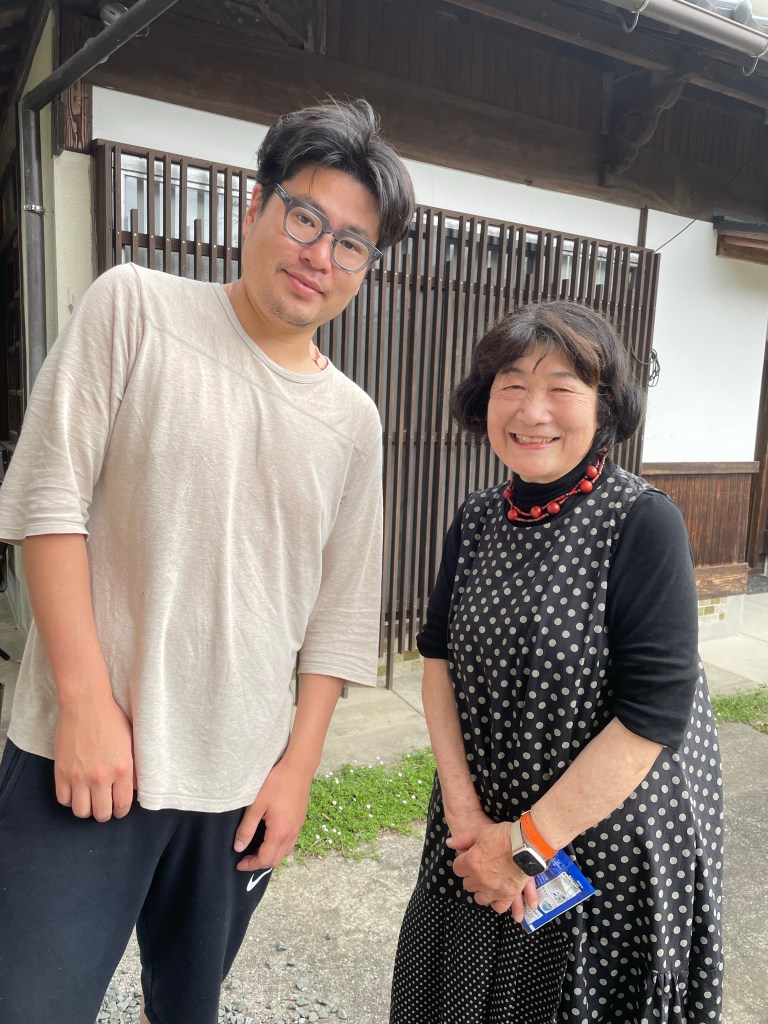
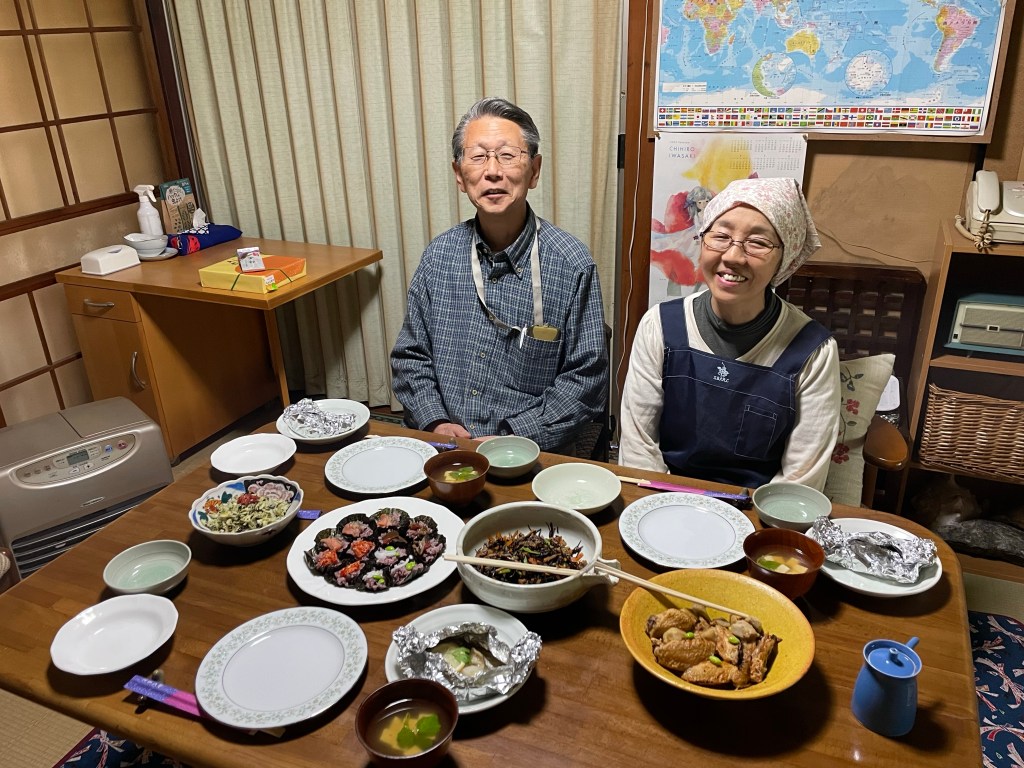
After animals crawled out of the sea almost 400 million years ago, it took many more millions of years of adaptation on land for them to reach full biological success. My sea to land transition has also required adaptation, but the time has been mercifully shorter, and I have been aided by Seigo and Miharu in their traditional Japanese environment.
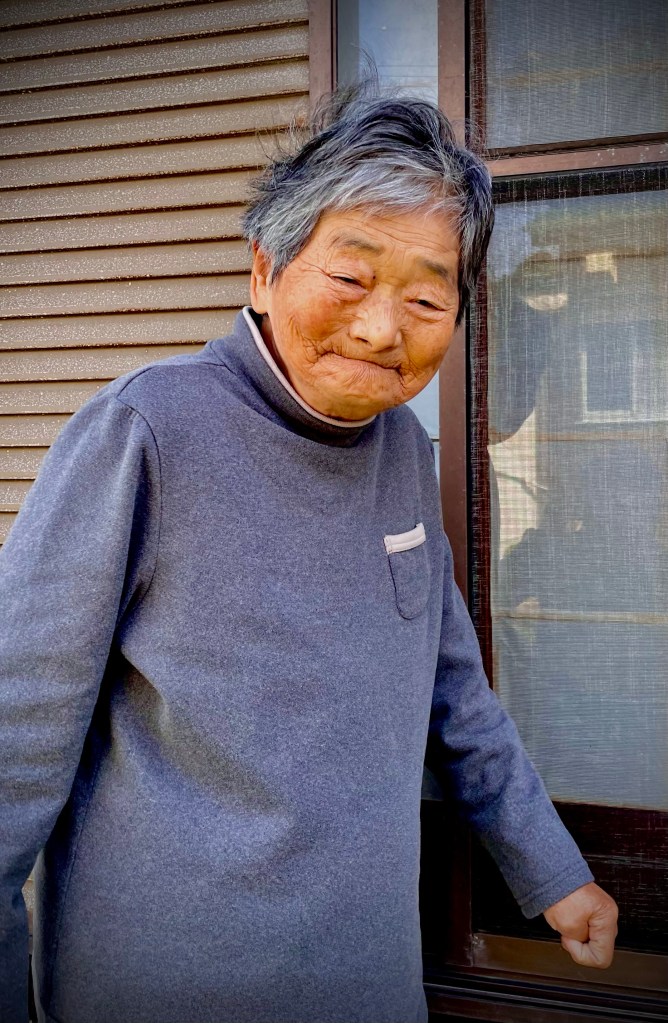
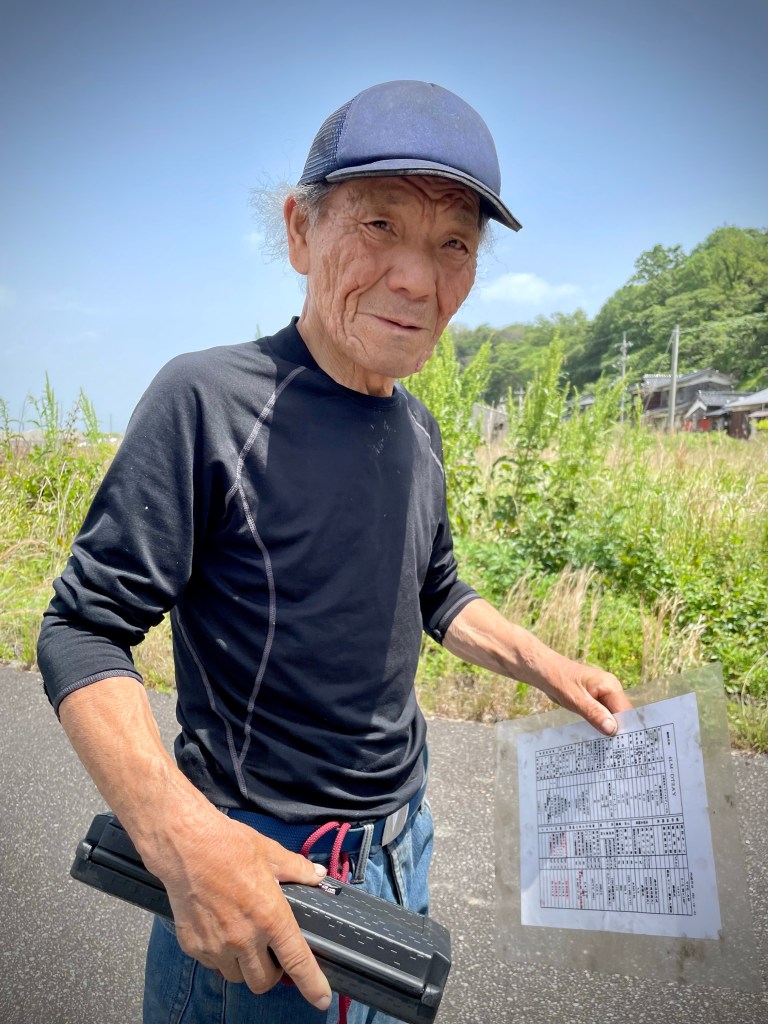
Seigo and MiharuTheir house
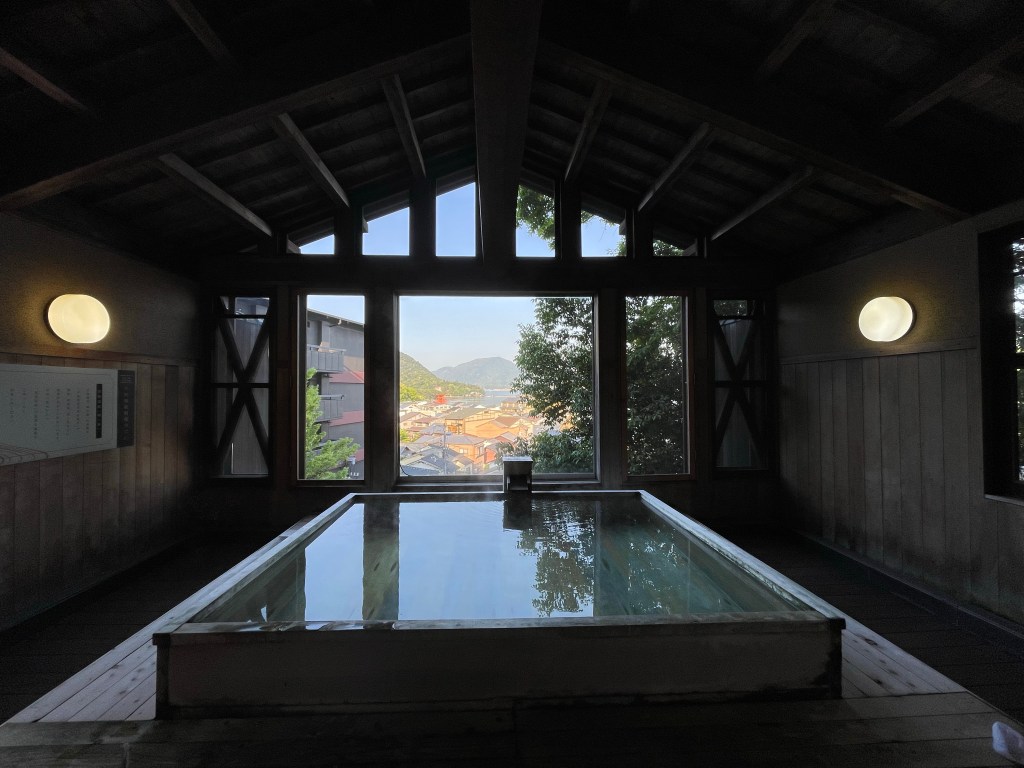
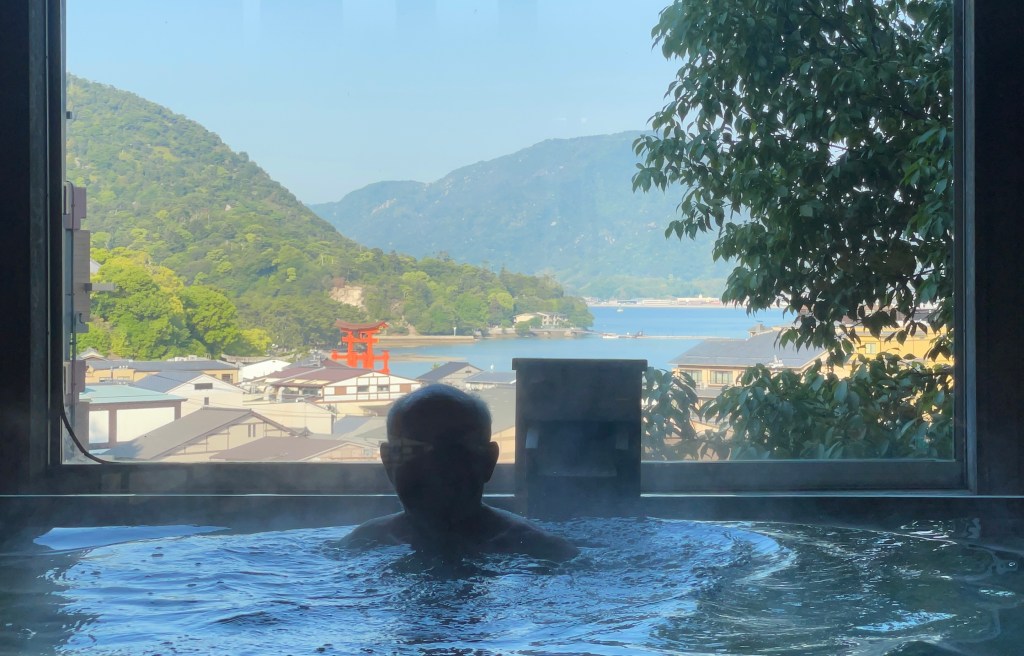
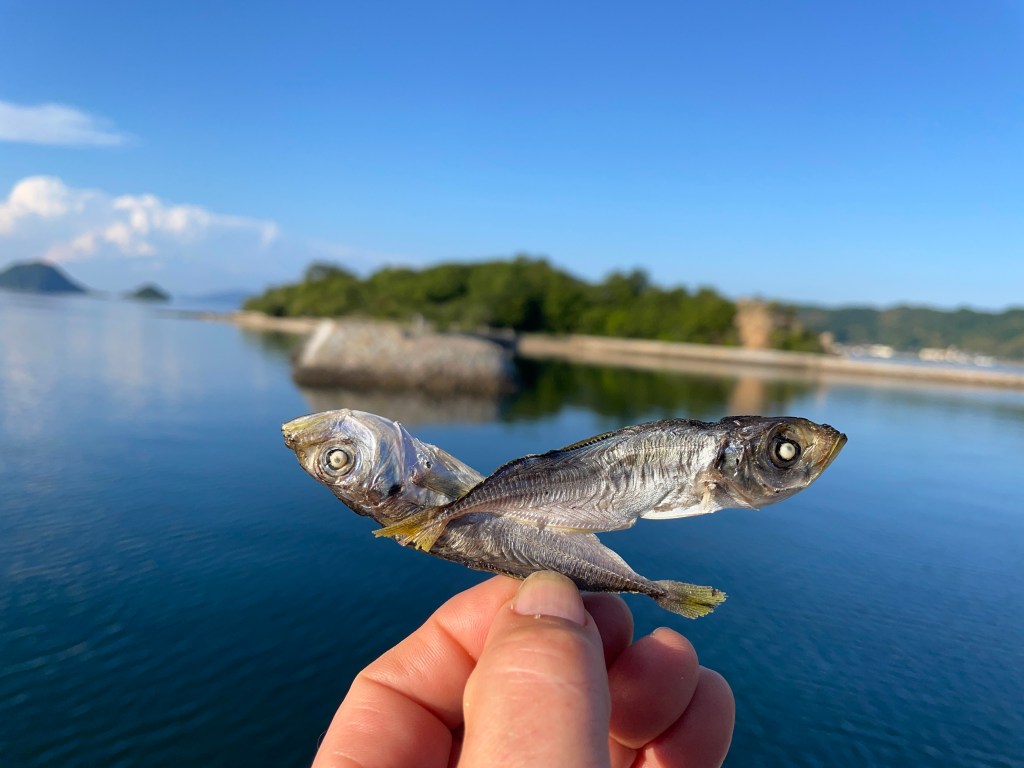
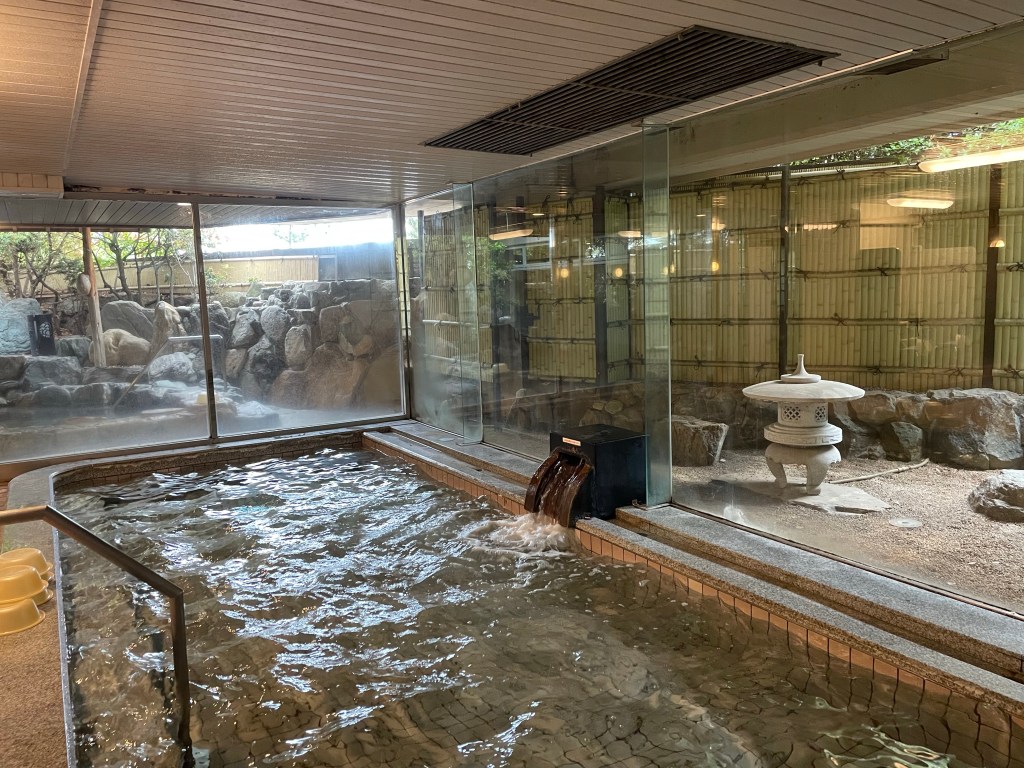
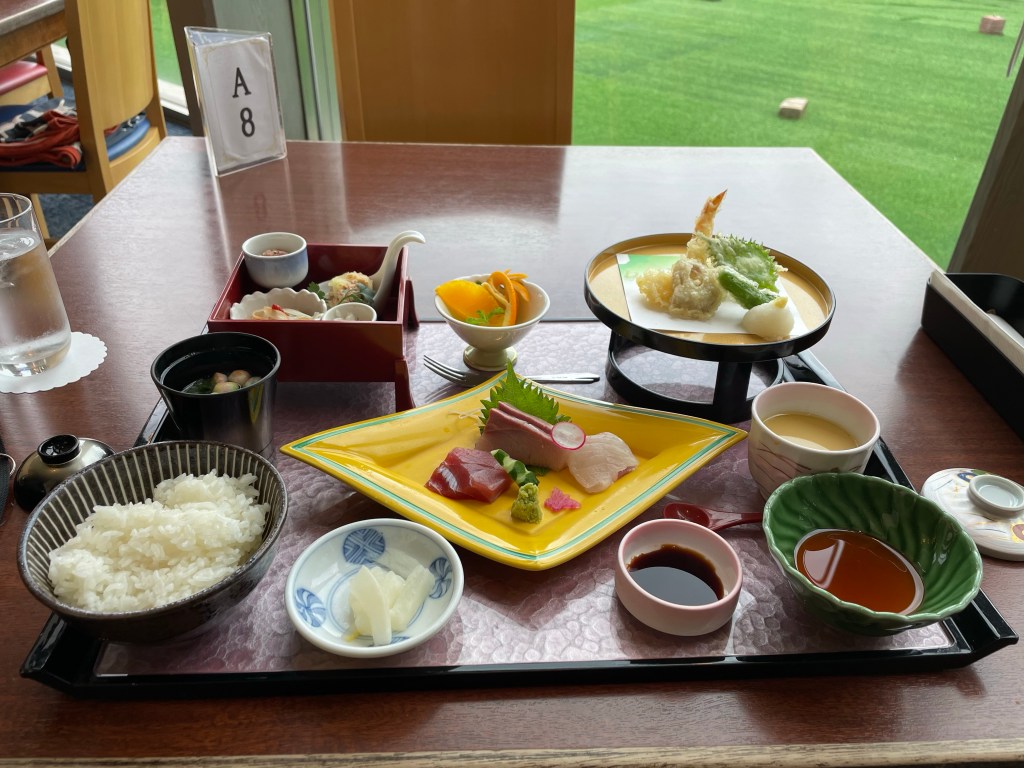
Other help has come from listening to music for the first time in six weeks and from eating fine Japanese cooking at every meal—after many breakfasts, lunches, snacks and dinners of dried fish and peanuts at sea. A professional massage and a visit to an outdoor hot spring have also helped… but I miss the exercise, the changing light on the water and the dipping and rolling of the horizon.
Love
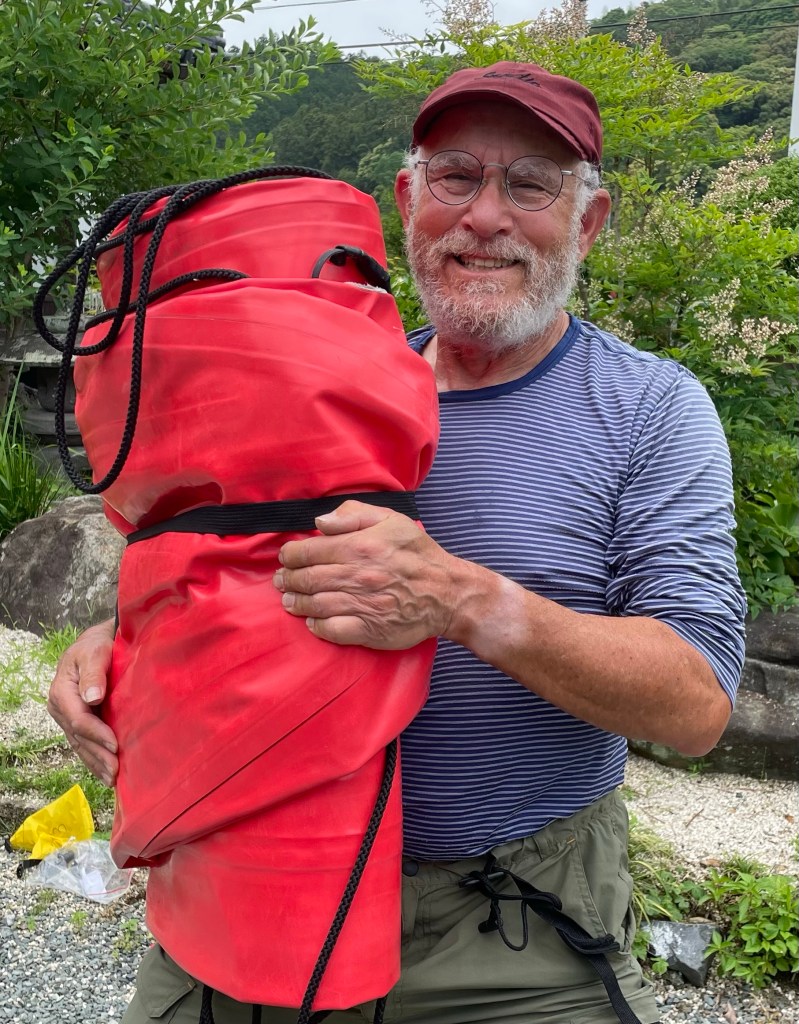
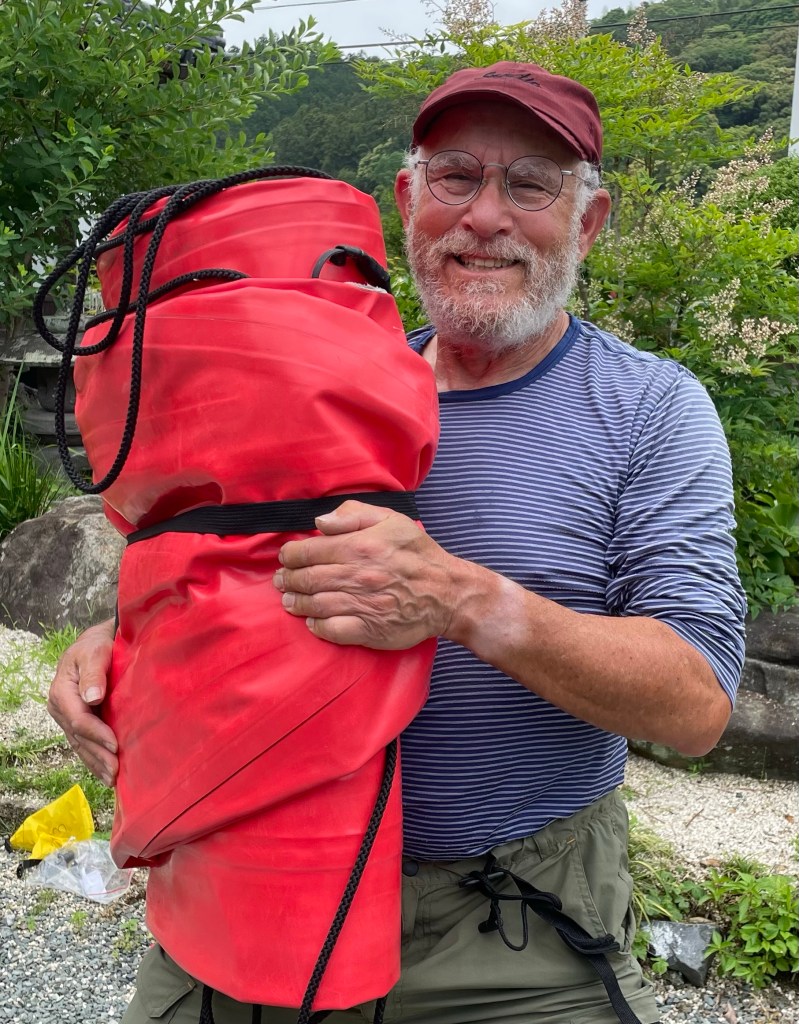
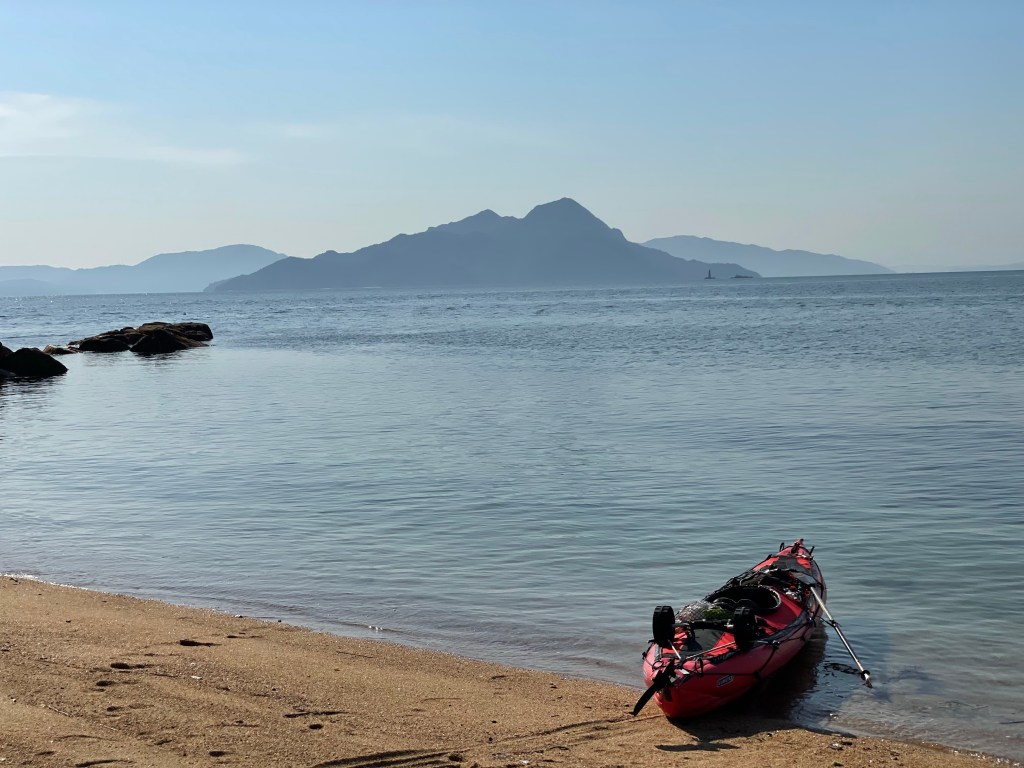
The kayak has been cleaned and returned to its bag after much complaining from it and many assurances from me that we will soon again ride the waves together. We will, and I hope that you will join us. In the meantime, here are links to previous kayak adventures:
Solo sea kayak/camping from Roscoff to Brest in Bretagne, France:
A duo sea kayak/camping celebration of our 50th wedding anniversary in Bretagne, France:
We loved kayaking the gentle Loire river in France. Here is a video I made in commemoration, after the death of my wife, Becky:
Sea kayaking (double) and camping from Toulon to Marseille in the Mediterranean Sea in southern France:
Whitewater kayaking on the Salmon River in Idaho, USA with raft support. Becky is in the yellow boat. She does an amazing paddle recovery at 2:34.
Double whitewater kayak/camping on the Allier River in central France:
———————
Après que les animaux sont sortis de la mer il y a près de 400 millions d’années, il leur a fallu encore des millions d’années d’adaptation sur terre pour réussir pleinement sur le plan biologique. Ma transition de la mer à la terre a aussi nécessité des adaptations, mais le temps a été heureusement plus court, et j’ai été aidé par Seigo et Miharu dans leur environnement japonais traditionnel.
Seigo and MiharuLeur maison
J’ai également pu écouter de la musique pour la première fois en six semaines et manger de la bonne cuisine japonaise à chaque repas – après des petits déjeuners, déjeuners, en-cas et dîners de poisson séché et de cacahuètes quand j’étais en mer. Un massage professionnel et un bain dans une source d’eau chaude en plein air m’ont également aidée… mais l’exercice physique, la lumière changeante sur l’eau et le plongeon et le roulis de l’horizon me manquent.
L’amour
Le kayak a été nettoyé et remis dans son sac après de nombreuses plaintes de sa part et de nombreuses assurances de la mienne que nous naviguerons bientôt à nouveau sur les vagues ensemble. Nous le ferons, et j’espère que vous vous joindrez à nous. En attendant, voici quelques liens vers des aventures précédentes en kayak :
Kayak (solo) de mer/camping entre Roscoff et Brest en Bretagne, France :
Brittany solo
Kayak de mer/camping pour célébrer notre 50e anniversaire de mariage en Bretagne, France :
Belle Îsle et environs
Nous avons adoré faire du kayak sur la Loire en France. Voici une vidéo que j’ai réalisée en guise de commémoration, après le décès de ma femme, Becky :
La Loire
Kayak de mer (double) et camping de Toulon à Marseille dans la mer Méditerranée dans le sud de la France :
Kayak d’eau vive sur la rivière Salmon dans l’Idaho, aux États-Unis, avec soutien de radeaux. Becky est dans le bateau jaune. Elle fait une incroyable récupération de la pagaie à 2:34.
Double kayak en eau vive/camping sur la rivière Allier dans le centre de la France :
I arrived on Kyushu (Moji Syounen) after an easy crossing thanks to tail winds. and waves. Surprise! I was greeted by the staff of a youth center, where they teach sea kayaking! I am dismantling the boat with a mixture of joy and sadness, for this has been such an intense adventure that it’s hard to imagine living a normal life. Am I addicted?
———
Je suis arrivé sur Kyushu (Moji Syounen) après une traversée facile grâce au vent arrière et aux vagues. Surprise! J’ai été accueilli par le personnel d’un centre de jeunesse, où l’on enseigne le kayak de mer (ils ont suivi ce blog). Je démonte le bateau avec un mélange de joie et de tristesse, car cette aventure a été tellement intense qu’il est difficile d’imaginer vivre une vie normale. Suis-je accro ?
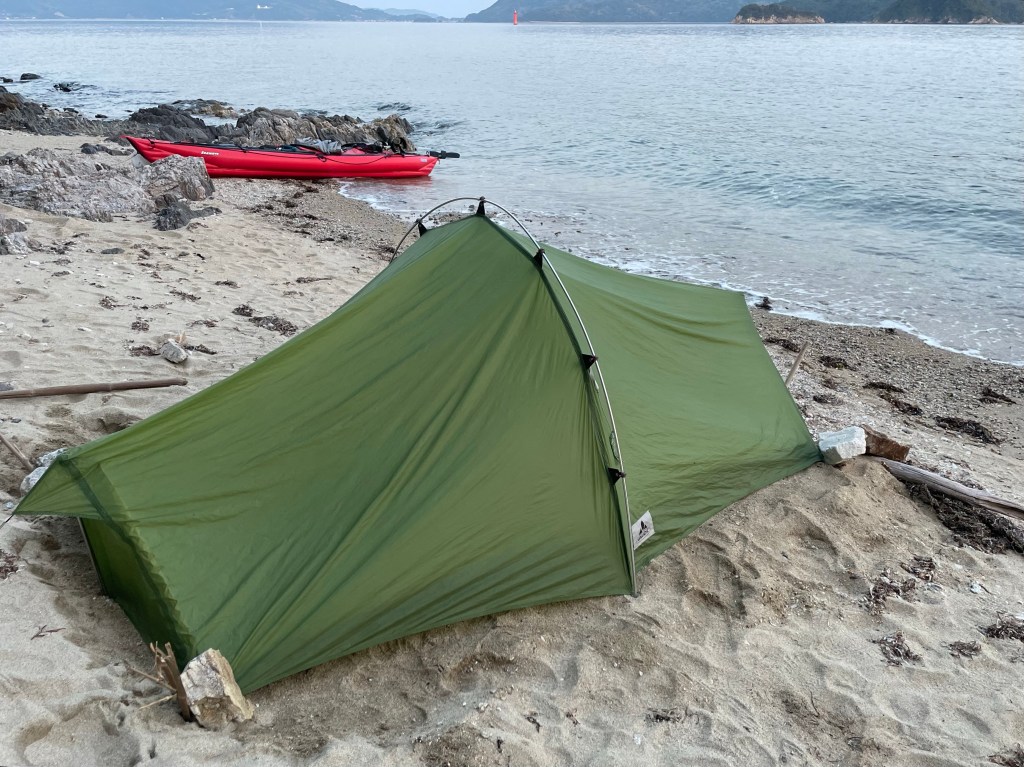
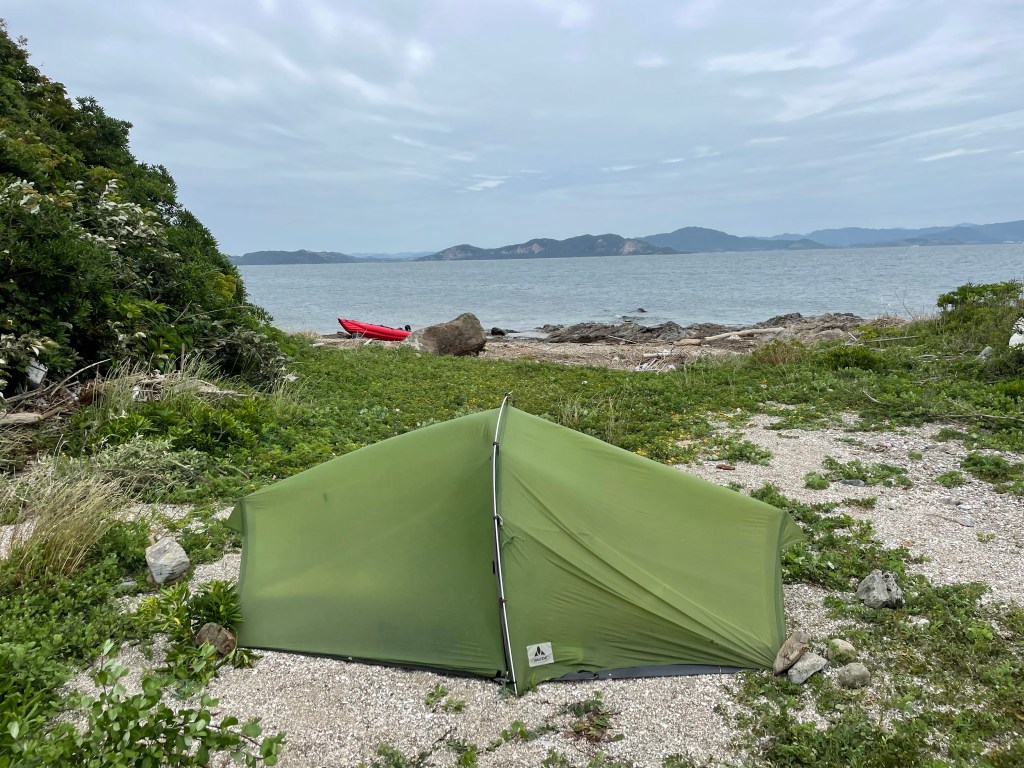
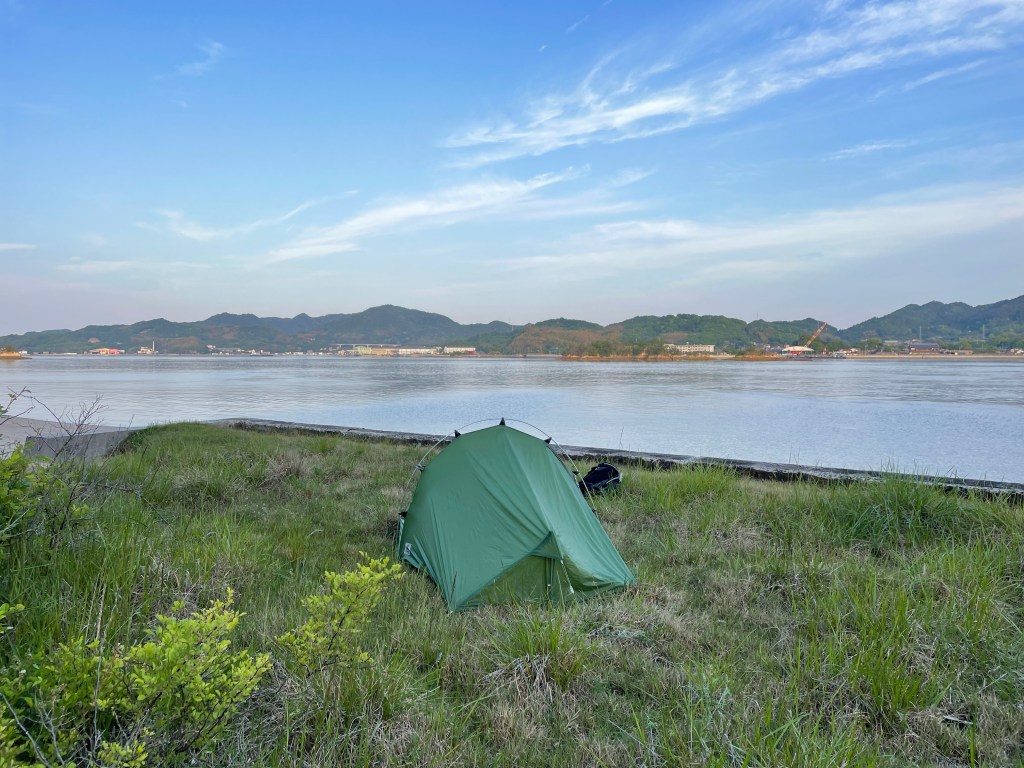
A day off in an official beach camp with new toilet facilities and views west and east! I’m adjacent to a fishing village on the island of No, just 75 km from my intended final destination of Kitakyushu. I have almost three weeks before returning to Paris, so time off on this island tempts… and the wind is too strong from the west to kayak farther. The camp site is free, and instead of sharpening sticks to drive into the sand, I used my tent stakes, pounded into flat, terra firma, three meters above the high tide level. In the last camp it took 40 minutes at dusk to carve out a flat place at the top of the beach, in the hope that the high tide would not flood me during the night. (It came within a few centimeters.) Here, there is nothing to worry about. The kayak is just below me on a shelf, also well above the high tide level. The beach is composed of small, flat stones, a welcome change from the fine sand that gets into everything.
The geology has changed. I’m at the western border of the Seto Sea National Park, at the end of my “islands everywhere” archipelago, with time to relax. I’ve just treated myself to a royal milk tea, hot from the vending machine in the village. Otherwise, it seems like there is nothing here, but a few fishing boats and elderly folks pushing carts, but nothing often hides something important. I think I’ll have another royal milk tea and further contemplate the meaning of nothing, but first, how about I look at this village?
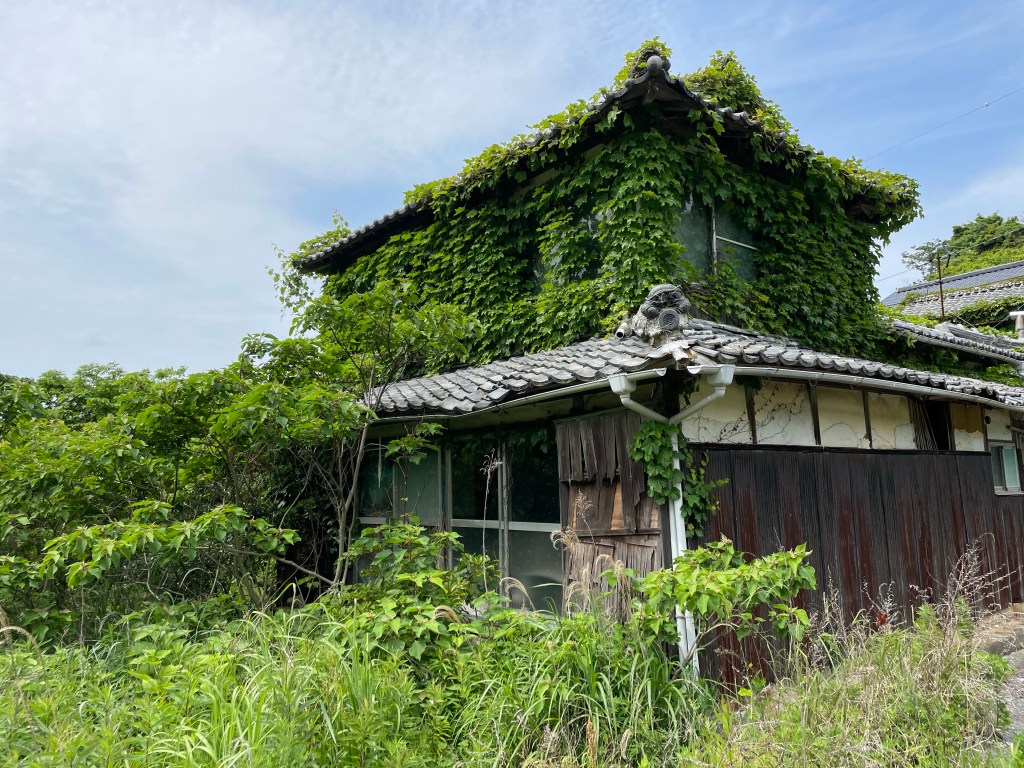
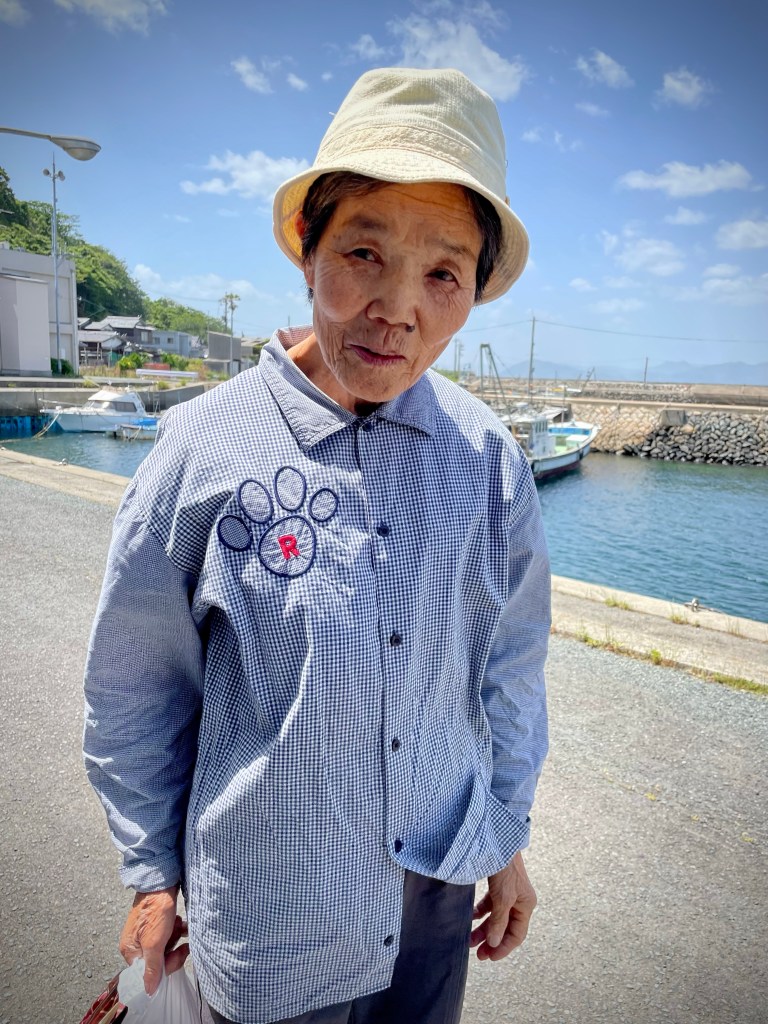
I found a community center, a school, a post office, a shop with a few basic supplies and a Buddhist Temple on the hill with a nice house by it, plus two Shinto shrines. But many of the houses in the village are abandoned. The windows are taped and boarded, and in some, vines have grown over the roofs and even inside the windows. The lady at the community center told me that there are nevertheless 60 people living here. The ferry from the mainland just arrived, and about 10 people got off. Some carried the spoils of supermarket shopping, so this is almost a ghost town for commerce; houses are being repossessed by nature; and the elderly reign. A statue of Kannon, the Buddhist God of mercy, guards the port. She holds a fishing pole and a red snapper. Kannon is all seeing. (The Canon camera company is named after her.) Environmental change has weakened the fisheries. There are seven children in the school, and they all come by ferry each morning. Kannon is crying.
Getting here since my last post was hard work, but always stimulating for visual delights and mental challenges, like playing the “rising tide floats all tents” game at night and navigating the storms, currents and winds. After waiting out the rain chez Kazoo and Mayumi in their traditional house on Suo-Oshima Island, I paddled and paddled and paddled, camping three nights under the stars, until another storm drove me to shelter in an onsen hotel, which had a natural hot spring with mild minerals that left a silkiness on my skin. The food was exceptional and the contrast between bivouacking and hotelling was deliciously decadent. The hotel was above the town and all the rooms and the public bath had splendid sea views.
One of the camps, on Sagojima, was on a perfect beach, chosen to be above the tide with an eastern exposure to the morning sun. However, it will be remembered not for this perfection, but rather for a scary incident. These islands are covered with dense jungle. As I was collecting sticks and rocks close to this foliage to secure the tent, my wilderness idyll was interrupted by a very near, loud, almost human cry, followed by a grown, a moan and then a guttural grunt. I froze as the adrenaline flowed. The hair on my head and neck went erect. I jumped back and grabbed a bamboo pole, fumbled for my pocket knife and prepared to flee in the kayak. But then I heard a familiar snort. The animal, just a couple meters away, was surely a wild boar, a species I know from France and other places in Japan. Relief! The adrenaline was quickly replaced by laughter. Boar are nocturnal pigs with tusks, and this one was probably having a bad dream. I slept well that night, with fireflies dancing, knowing that boar don’t attack humans, but ironically, they do in my second novel, Serendipity, which is the follow up to Shikoku, available in English, French and Japanese, and the first in the series of four, with three more to publish.
I’ve now spent a second day on No Island, because strong headwinds winds have made it impossible to kayak westward. There is much to see and try to understand here, and the man in the shop just invited me to his house for dinner!
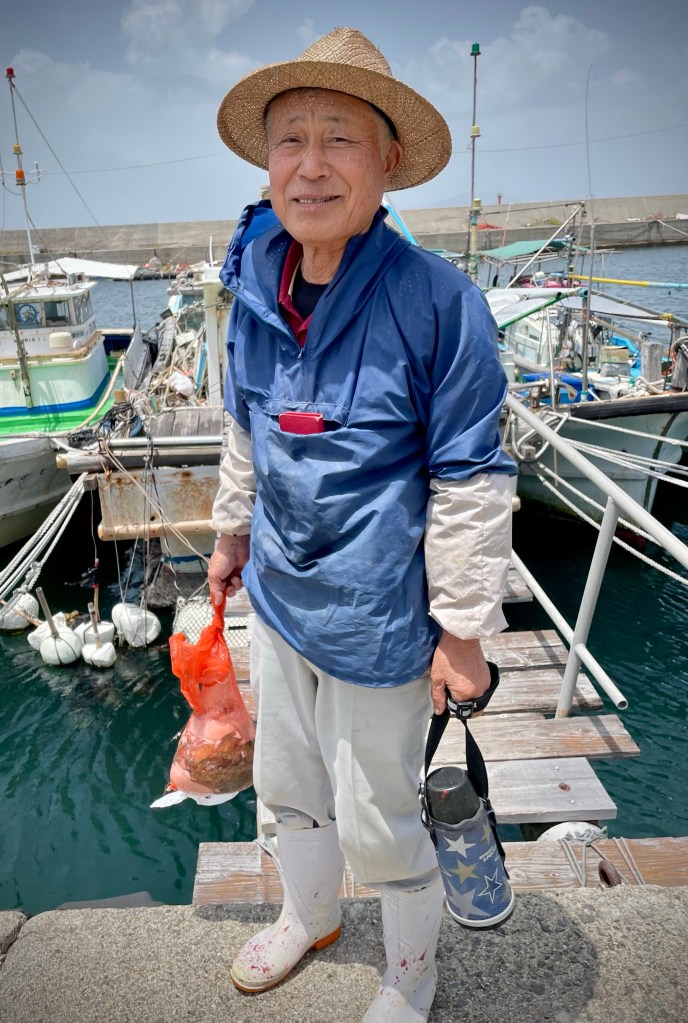
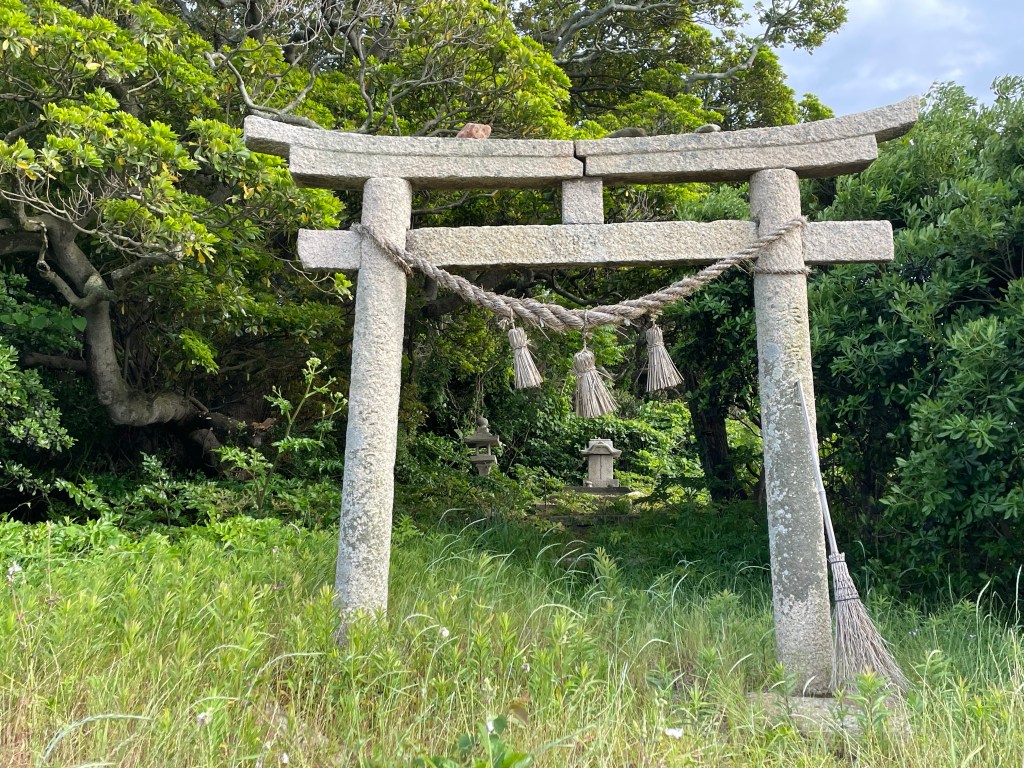
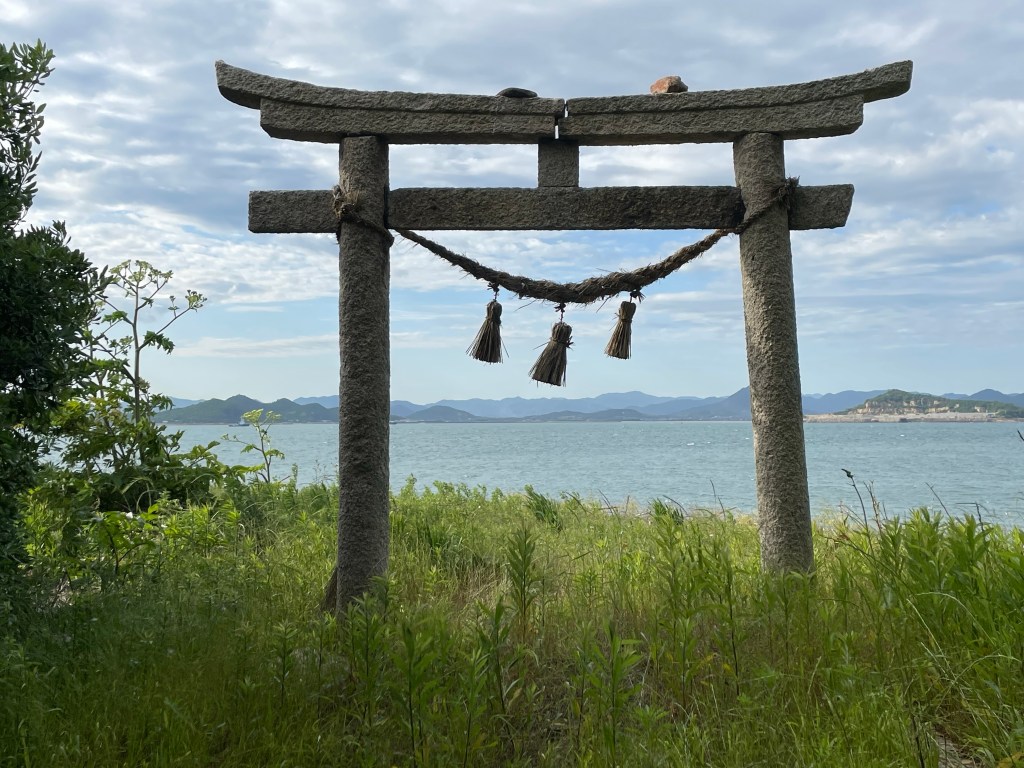
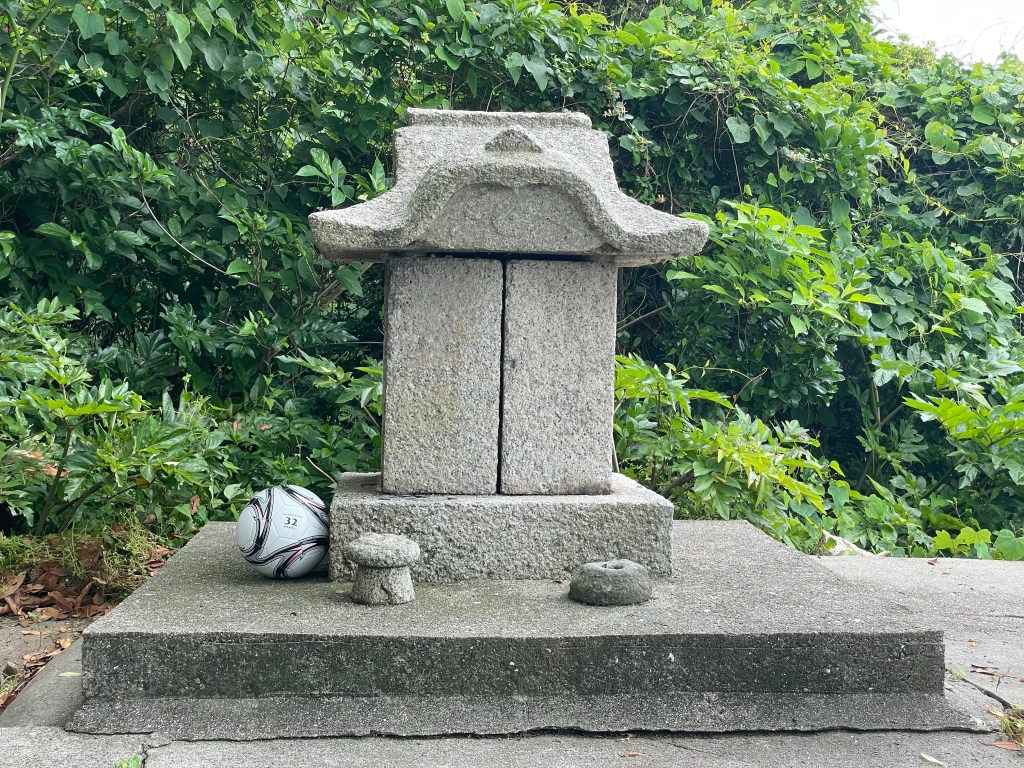
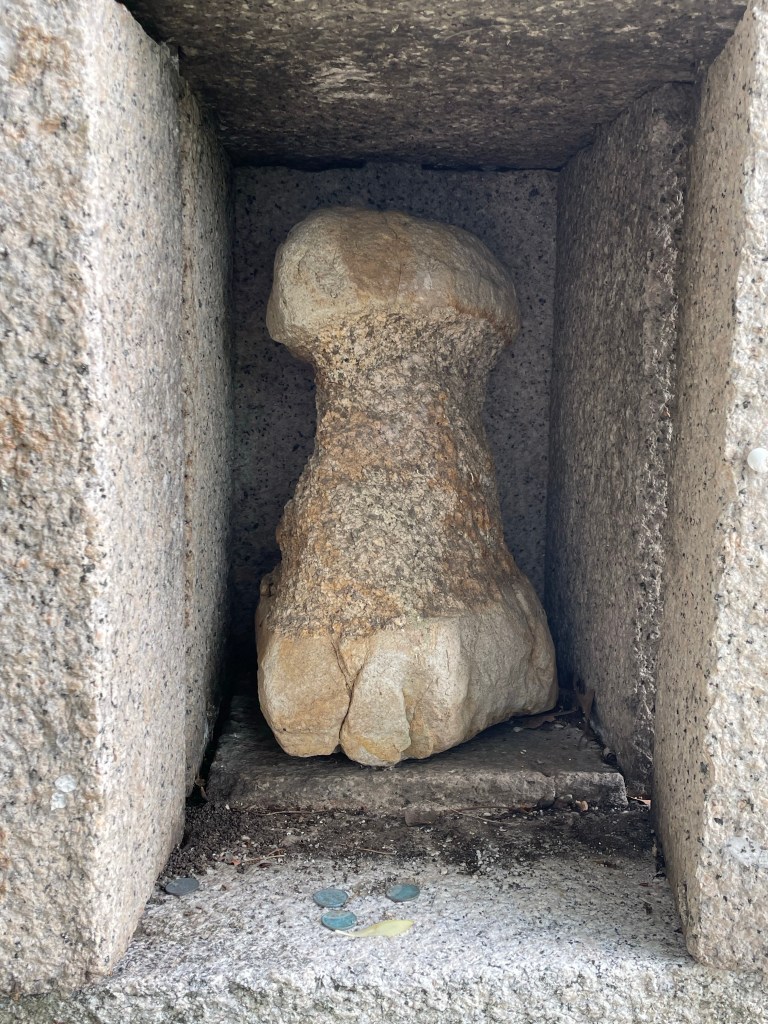
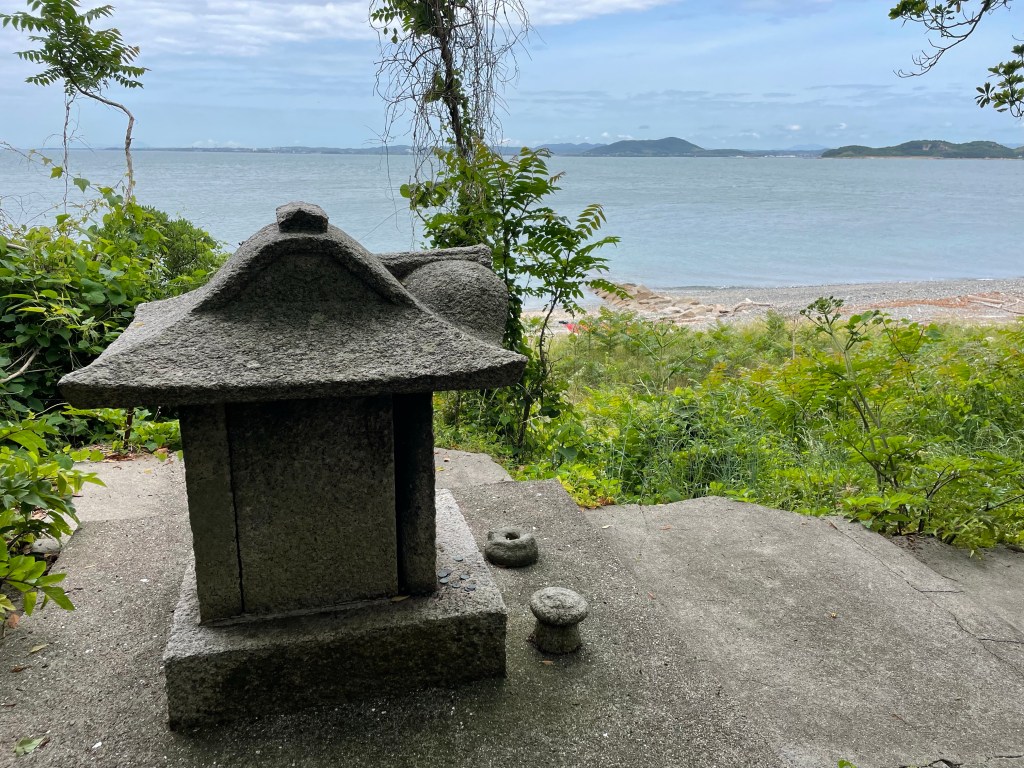
The dinner with Kazue and Ichikawa was a delicious departure from my diet of dried fish and peanuts, and thanks to our telephones’ simultaneous translations, I got to know them and learn more about the village, where they have lived for 30 years, experiencing the decline in the fishing business and the aging of the population. I next paddled over six hours, nonstop, to Saba Island, much of it against head winds, but the effort was worth it for the perfect campsite and the climb to lighthouse above. Takeshima was next, but this time I was helped by a tailwind and large waves pushing me forward. I camped near the Shinto shrine, a simple and exceptionally beautiful piece of peace. I found a traditional bamboo broom on the beach in good condition and spent part of the morning cleaning the shrine of leaves and removing plants growing in the cracks. I also found a new soccer ball on the beach and left it as an offering, along with a ¥500 coin. I hope the Goddess finds someone to play with. These were my last islands. Both of them are exceptionally small, uninhabited and unusually beautiful. I could have used a week on each one.
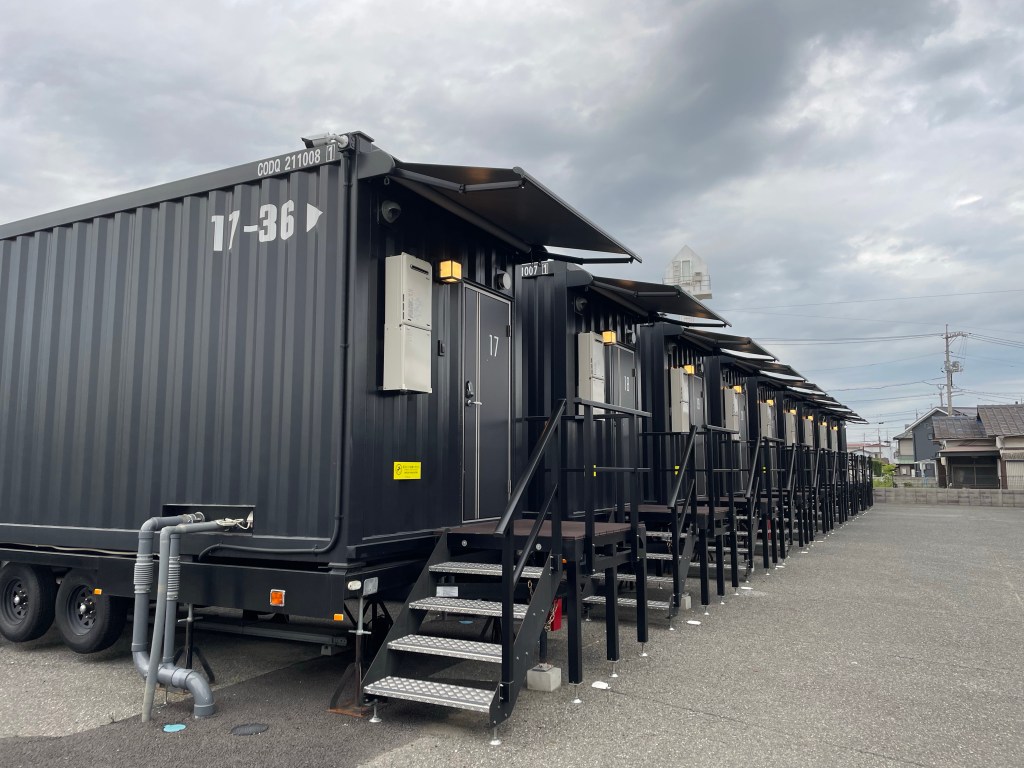
I next made it to the city of Ube with a strong wind and waves helping me. For a little contrast, I’m staying in a container hotel. Each room is a shipping container. Tomorrow I’ll cross to the big island of Kyushu, which was my originally intended, final destination. But who knows? Maybe the wind will push me all the way to Busan, South Korea. There’s a typhoon not far to the south that could provide the necessary adrenaline.
———-
Une journée de repos dans un camping officiel avec de nouvelles sanitaires et une vue sur l’ouest et l’est ! Je suis à côté d’un village de pêcheurs sur l’île de No, à seulement 75 km de ma destination finale prévue, Kitakyushu. J’ai presque trois semaines avant de retourner à Paris, donc du temps libre sur cette île me tente… et le vent de l’ouest est trop fort pour continuer. Le terrain de camping est gratuit, et au lieu d’improviser des piquets de tente avec des bouts de bois enfoncés dans le sable, j’ai utilisé mes vrais piquets de tente, sur terra firma, à trois mètres au-dessus du niveau de la marée haute. Dans le dernier camp, il a fallu 40 minutes au crépuscule pour sculpter un endroit plat au sommet de la plage, dans l’espoir que la marée haute ne m’inonderait pas pendant la nuit. (L’eau est monté à quelques centimètres de mon platform.) Ici, il n’y a rien à craindre. Le kayak est juste en dessous de moi, bien au-dessus du niveau de la marée haute. La plage est composée de petites pierres plates, un changement bienvenu par rapport au sable fin qui pénètre dans tout.
La géologie a changé. Je suis à la frontière ouest du Parc National de la Mer de Seto, au bout de mon archipel “îles partout”, avec du temps de me détendre. Je viens de m’ offrir un thé au lait royal, livré chaud du distributeur automatique du village. Sinon, il semble qu’il n’y ait rien ici, juste quelques bateaux de pêche et des personnes âgées qui poussent des charrettes, mais “rien” cache souvent quelque chose d’important. Je pense que je vais prendre un deuxième thé et réfléchir davantage au sens du “rien”, après avoir exploré ce village.
J’ai trouvé un centre communautaire, une école, un bureau de poste, une boutique avec quelques fournitures de base et un temple bouddhiste sur la colline avec une belle maison à côté, et en plus, deux sanctuaires shintoïstes. Mais beaucoup de maisons du village sont abandonnées. Les fenêtres sont scellées et bordées, et dans certaines, les vignes ont poussé sur les toits et même à l’intérieur des fenêtres. La dame du bureau du gouvernement m’a dit qu’il y a néanmoins 60 personnes qui vivent ici. Le ferry vient d’arriver, et environ 10 personnes sont descendues. Certains portaient le butin des achats dans les supermarchés, c’est donc presque une ville fantôme pour le commerce ; les maisons sont reprises par la nature ; et les personnes âgées règnent. Une statue de Kannon, la déesse bouddhiste de la miséricorde, garde le port. Elle tient une canne à pêche et un poisson. Kannon voit tout. (La société d’appareils photo Canon porte son nom.) Mais les changements environnementaux d’origine humaine ont affaibli les pêches. Il y a sept enfants à l’école, et ils viennent tous en ferry chaque matin. Kannon pleure.
Arriver à l’isle de No depuis mon dernier compte rendu a été un défi physique et en même temps une joie pour les délices visuels et le plaisir de naviguer dans les tempêtes, les courants et les vents. Après avoir attendu la fin de la pluie chez Kazoo et Mayumi dans leur maison traditionnelle, j’ai pagayé, pagayé et pagayé, campant trois nuits sous les étoiles, jusqu’à ce qu’une autre tempête me conduise à l’abri dans un hôtel onsen, qui avait une source chaude naturelle avec des minéraux doux qui laissaient une soie sur ma peau. La nourriture était exceptionnelle et le contraste entre le bivouacking et l’hôtellerie était délicieusement décadent. L’hôtel était au-dessus de la ville et toutes les chambres et le bain public avaient une vue splendide sur la mer.
L’un des camps, sur Sagojima, se trouvait sur une plage parfaite, choisie pour être au-dessus de la marée avec une exposition orientale au soleil du matin. Cependant, je m’en souviendrai non pas pour cette perfection, mais plutôt pour un incident effrayant. Ces îles sont couvertes d’une jungle dense. Alors que je collectionnais des bâtons et des roches près de ce feuillage pour sécuriser la tente, mon idylle sauvage a été interrompue par un cri très proche, fort, presque humain, suivi d’un gémissement, puis d’un grognement guttural. J’ai sauté en arrière ; j’ai attrapé un bâton de bambou ; je me suis préparé à fuir dans le kayak. Et puis, j’ai entendu un reniflement familier. L’animal, à seulement quelques mètres de moi, était sûrement un sanglier, une espèce que je connais en France et dans d’autres endroits au Japon. Soulagement ! L’adrénaline a été rapidement remplacée par le rire. Les sangliers sont des cochons nocturnes avec des défenses, et celui-ci faisait probablement un mauvais rêve. J’ai bien dormi cette nuit-là, sachant qu’ils n’attaquent pas les humains, mais ironiquement, ils le font dans mon deuxième roman, Serendipity, qui sera la suite de Shikoku.
J’ai maintenant passé une deuxième journée sur No, à cause de vents forts venant de l’ouest. Il y a beaucoup à voir et à essayer de comprendre, et l’homme de la boutique vient de m’inviter chez lui pour dîner !
Le dîner avec Kazue et Ichikawa était un délicieux changement par rapport à mon régime de poisson séché et de cacahuètes, et grâce aux traductions simultanées par nos téléphones, j’ai pu les connaître et en apprendre davantage sur le village, où ils vivent depuis 30 ans, tout en subissant le déclin de l’activité de pêche et le vieillissement de la population.
J’ai ensuite pagayé pendant plus de six heures, sans arrêt, jusqu’à l’île de Saba, la plupart du temps contre des vents contraires, mais l’effort en valait la peine pour le camping parfait et l’ascension au phare situé au-dessus. L’île de Takeshima était l’arrêt suivant, mais cette fois-ci, j’ai été aidé par un vent arrière et de grosses vagues qui m’ont poussé vers l’avant. J’ai campé près du sanctuaire Shinto, un lieu de paix simple et exceptionnellement beau. J’ai trouvé sur la plage un balai traditionnel en bambou en bon état et j’ai passé une partie de la matinée à nettoyer le sanctuaire des feuilles et à enlever les plantes qui poussaient dans les fissures. J’ai également trouvé un ballon de foot en bon état sur la plage et je l’ai laissé en offrande, avec une pièce de 500 ¥. J’espère que le dieu trouvera quelqu’un avec qui jouer. Ce sont mes dernières îles. Elles sont petites, inhabitées et magnifiques. J’aurais pu passer une semaine sur chacune.
J’ai ensuite atteint la ville d’Ube, aidé par un vent fort et des vagues. Pour un peu de contraste, j’y loge dans un hôtel composé de conteneurs. Chaque chambre est un conteneur d’expédition posé dans un parking. Demain, je ferai la traversée pour atteindre la grande île de Kyushu, qui était ma destination finale initialement prévue. Mais qui sait ? Peut-être que le vent me poussera jusqu’à Busan, en Corée du Sud. Il y a un typhon pas très loin qui pourrait fournir l’adrénaline nécessaire.
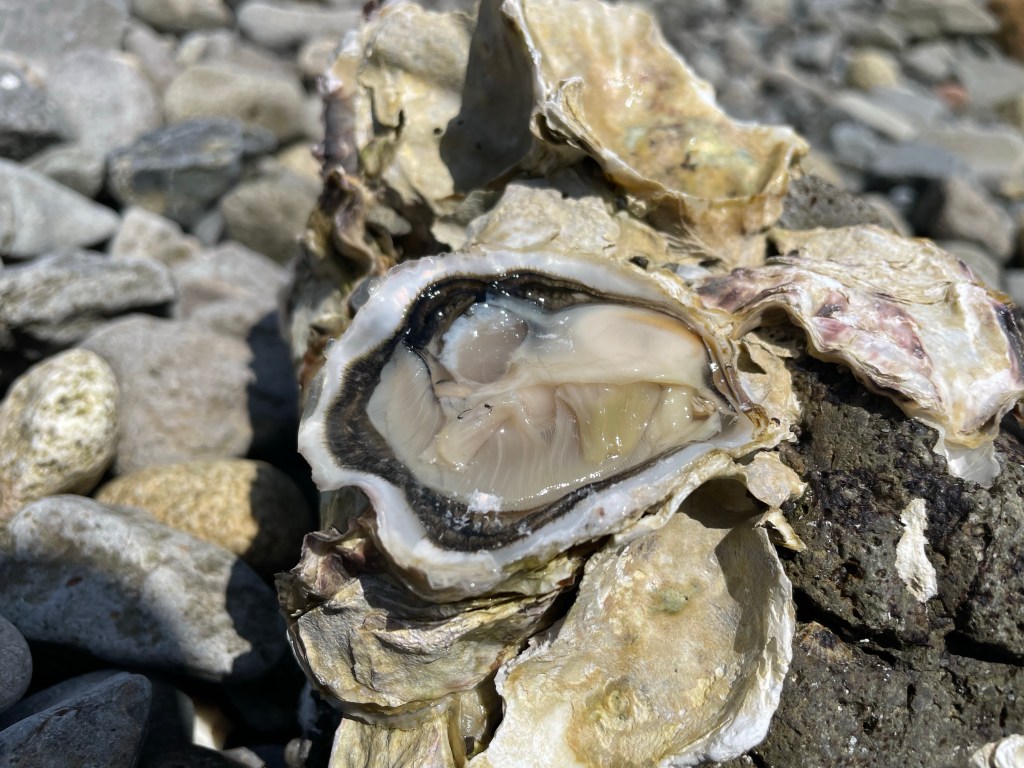
Dried squid for lunchWild oysters on the beach. Oishi!Wild boar sunset (Sago Island)Caught between wild boar on the left and high tide on the right (Sago Island)Kannon, god of mercy (No Island)
Sea life, No Island One of many abandoned houses on No IslandFirst in a series of portraits of residents of No IslandMakoto, school principal on No Island Homemade board game found under a bench by the ferry terminal at No Island Kasue and TakefumeSaba Island dream campApproach to the Shinto shrine on Takeshima Inside the alter
A guided tour of the shrine
Paddling with a tailwind Container hotel Fashion in Ube
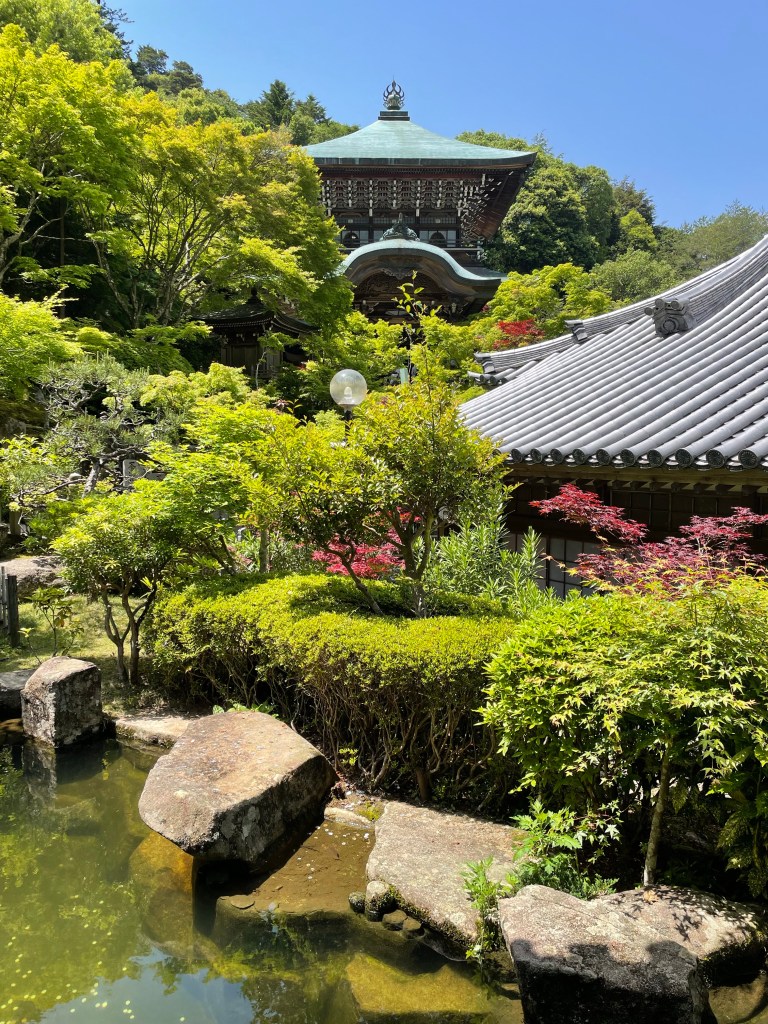
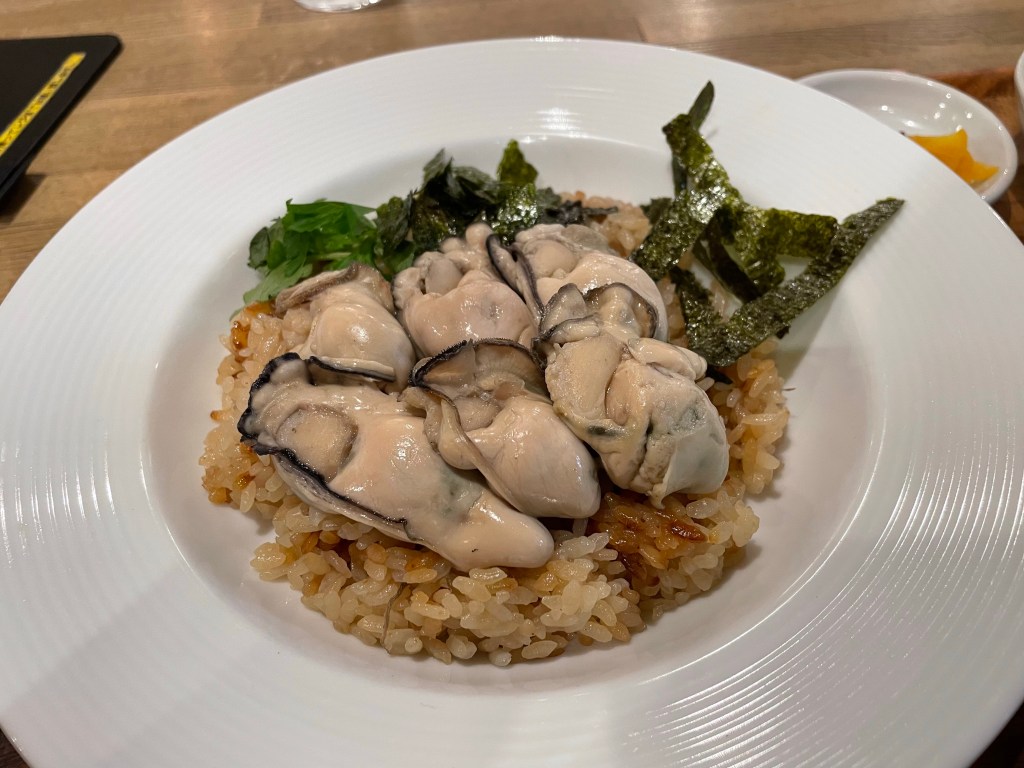
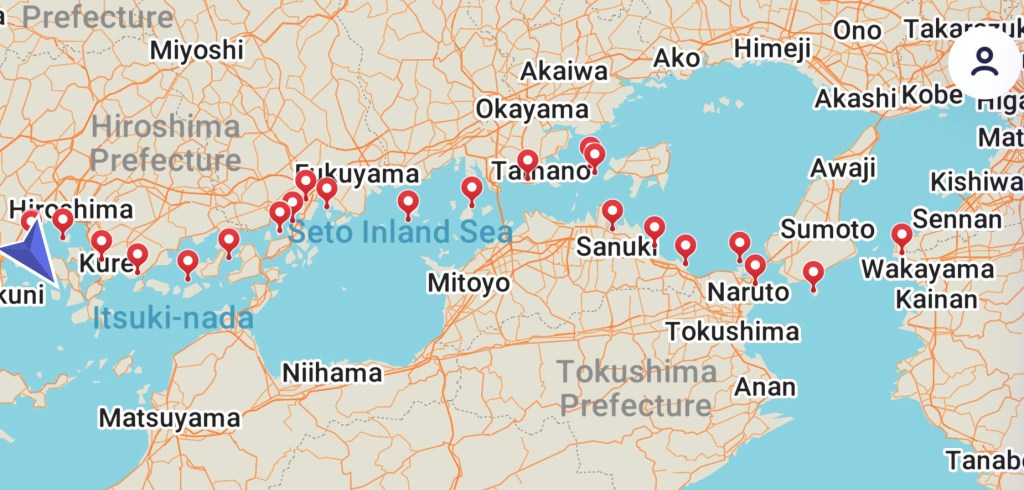
Miyajima was an unintended detour. This island, close to Hiroshima, is a tourist cliché, visited briefly in 2003, and not a destination for a kayaker seeking solitude. Surprise! Once again, the boat was right. Miyajima was not overrun with fellow tourists, and I saw lots of deer and a solitary monkey. It’s a place to eat oysters and and above all to discover the Shinto/Buddhist fusion. My visit included a climb and descent of Mount Missen (546 m), a challenge to the kayaker, who has hardly used his legs in a month. The next two days were devoted to solitary paddling, far from anything, with only reminders of human civilization. A moment with no wind had me thinking that the sea surface was a giant Ouija board with the kayak as the planchette. I’m now on Suo-Oshima Island, where I took refuge yesterday in a rainstorm. I’m the only guest in a traditional house, run by a charming couple. The weather has cleared, and the sun is setting behind the mountains of Honshu. I’m sitting on the seawall that forms the harbor, watching the parade of islands glide along the seascape, propelled by the light.
Miyajima était un détour involontaire. Cette île, proche d’Hiroshima, est un cliché touristique, visitée brièvement en 2003, et non une destination pour un kayakiste en quête de solitude. Surprise ! Une fois de plus, le bateau avait raison. Miyajima n’était pas envahi par les touristes, et j’ai vu beaucoup de cerfs et un singe solitaire. C’est un endroit où l’on peut manger des huîtres et surtout découvrir la fusion shinto/bouddhiste. Ma visite comprenait l’ascension et la descente du mont Missen (546 m), un défi pour le kayakiste qui n’a pratiquement pas utilisé ses jambes depuis un mois. Les deux jours suivants ont été consacrés à la pagaie solo, loin de tout, avec seulement des rappels de la civilisation humaine. Un moment, sans vent, m’a fait penser que la surface de la mer était une planche de Ouija géante dont le kayak était la planchette. Je suis maintenant sur l’île de Suo-Oshima, où je me suis réfugié hier lors d’une tempête de pluie. Je suis la seule invitée dans une maison traditionnelle, tenue par un couple charmant. Le temps s’est dégagé et le soleil se couche derrière les montagnes de Honshu. Je suis assis sur la digue qui forme le port et je regarde le défilé d’îles qui glissent sur le paysage marin, poussés par la lumière.
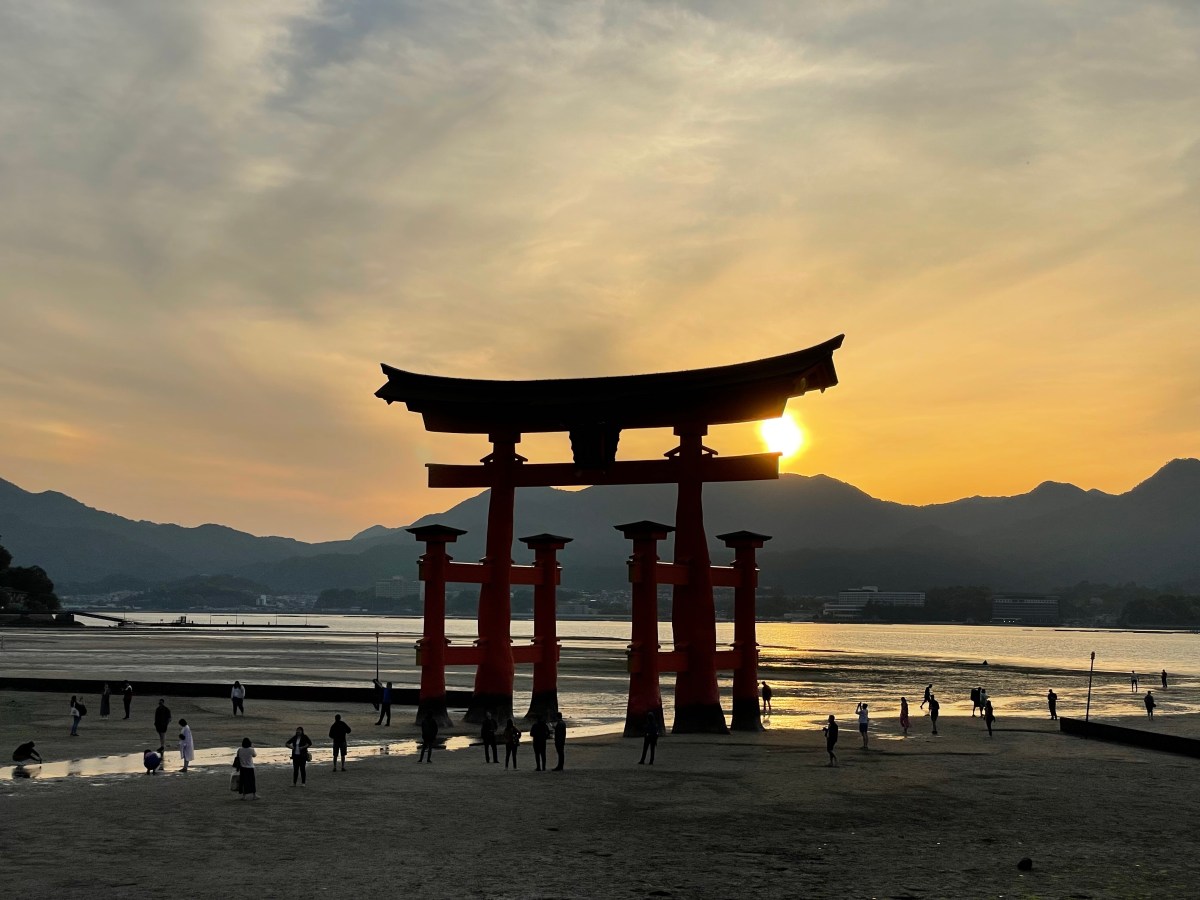
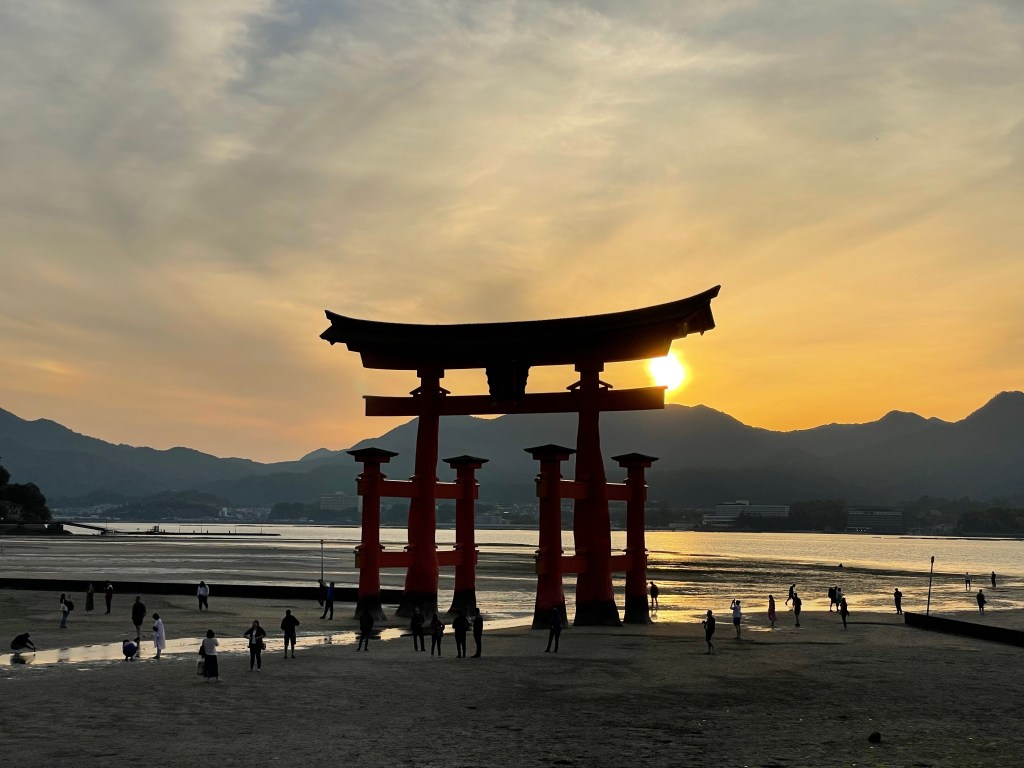
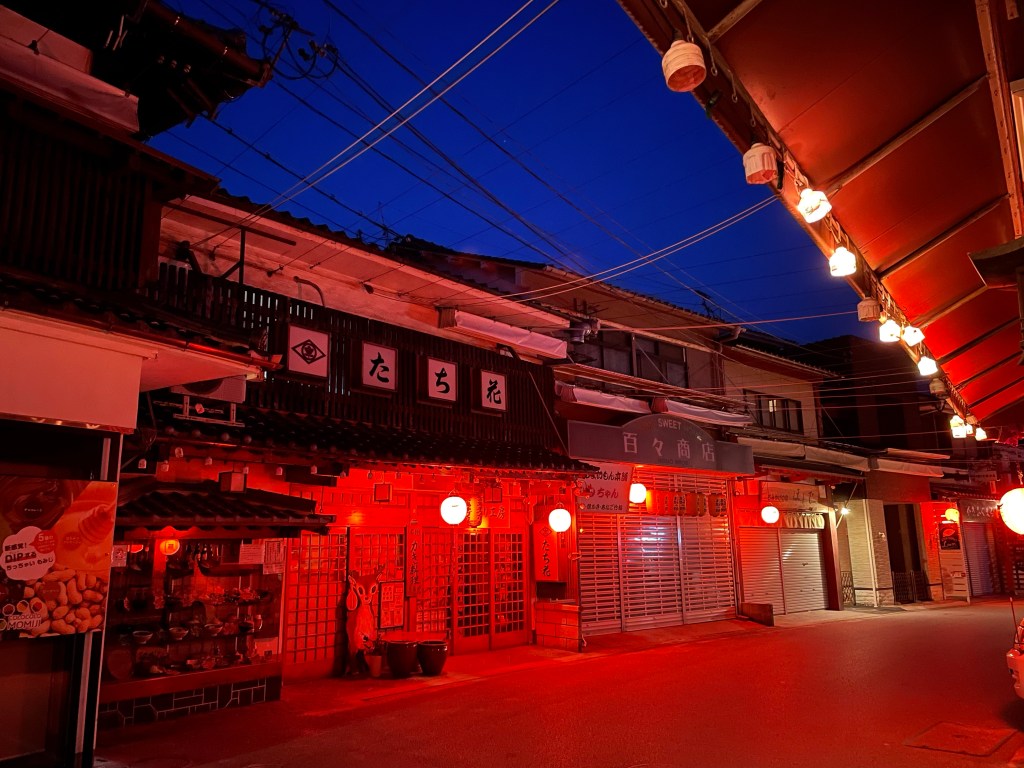
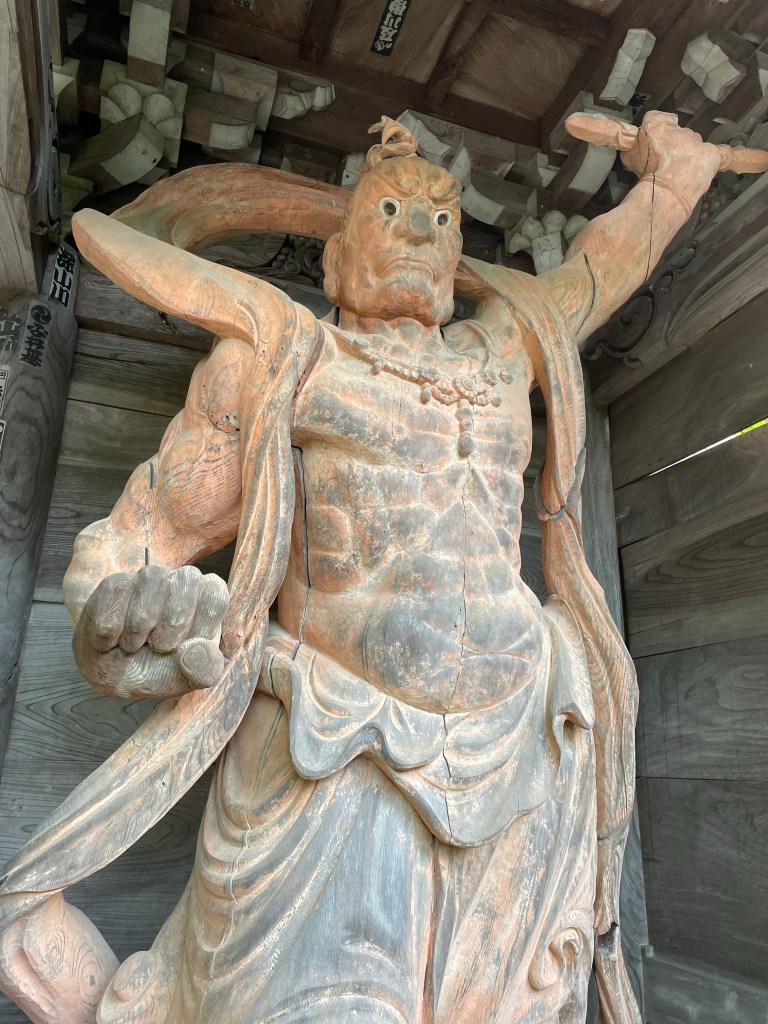
Torii and human admirers Miyajima by night David after a month of kayaking Daisho-in Temple, Miyajima
Daisho-in interior
Horizon turn from Mount Missen Oysters on rice. Ouishi!Bath with a view Torrid toriiiGoing my way?
Horizon turn on Seto Sea ouija board Container ship ONE night passage
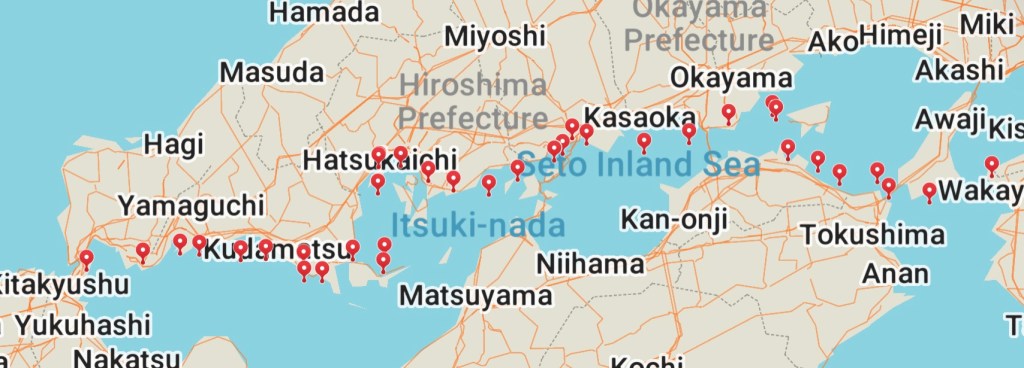
Moon campKazoo and MayumiDinner (Mind your manners. They’re watching you eat them)Islands of islands Last rays Light parade Since Wakayama, far right, on April 13
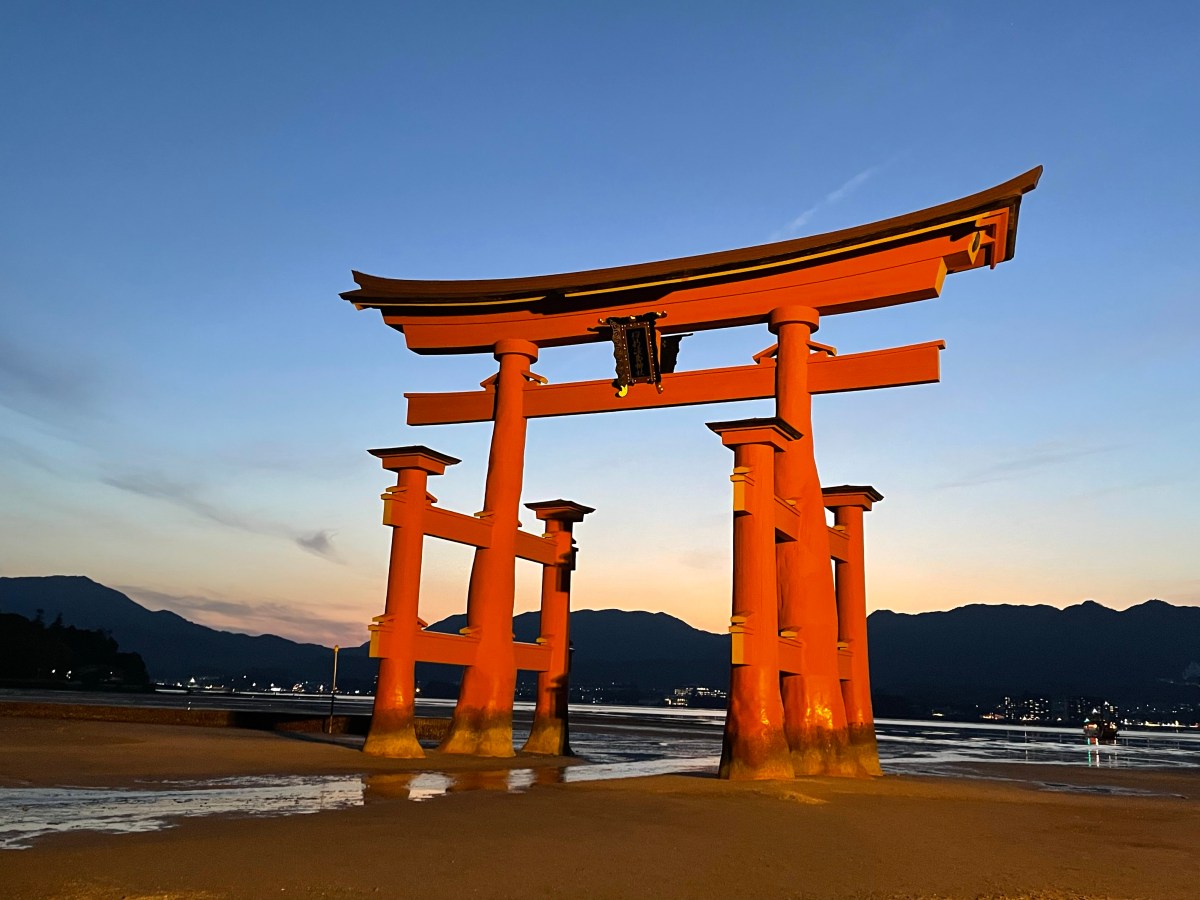
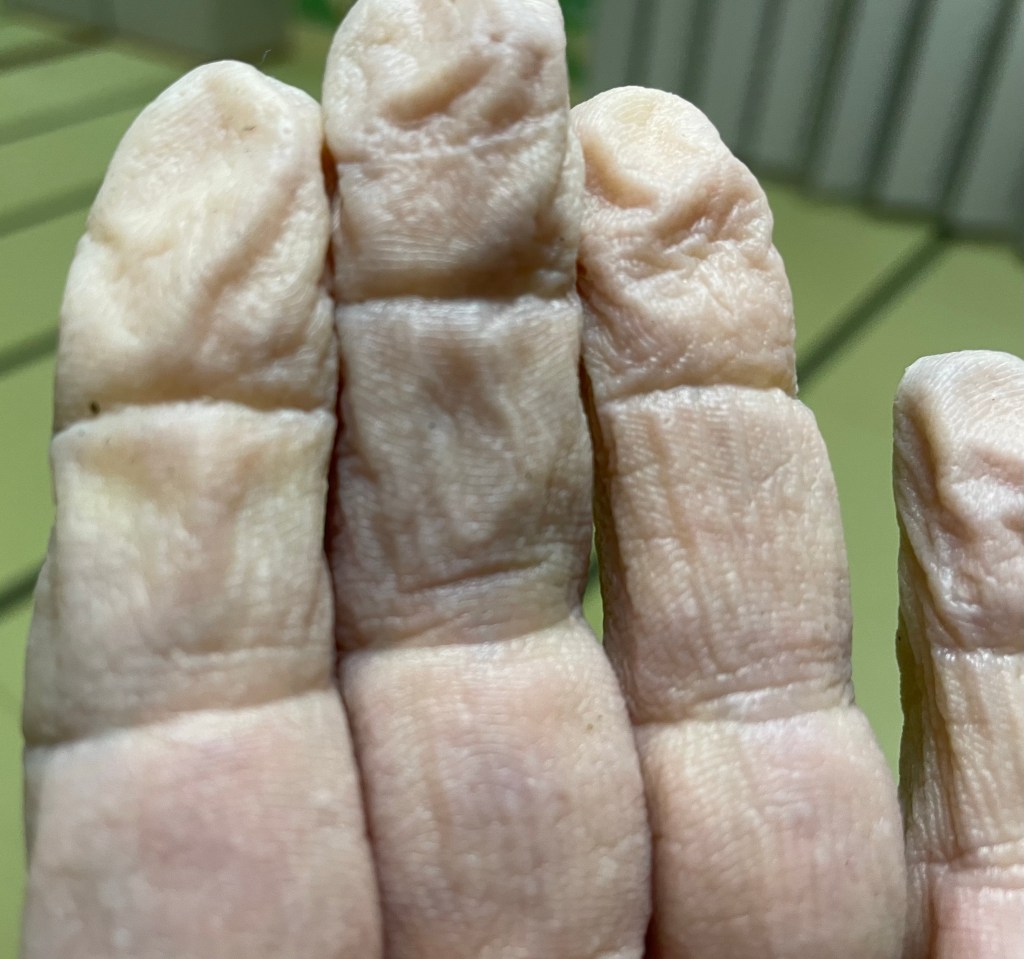
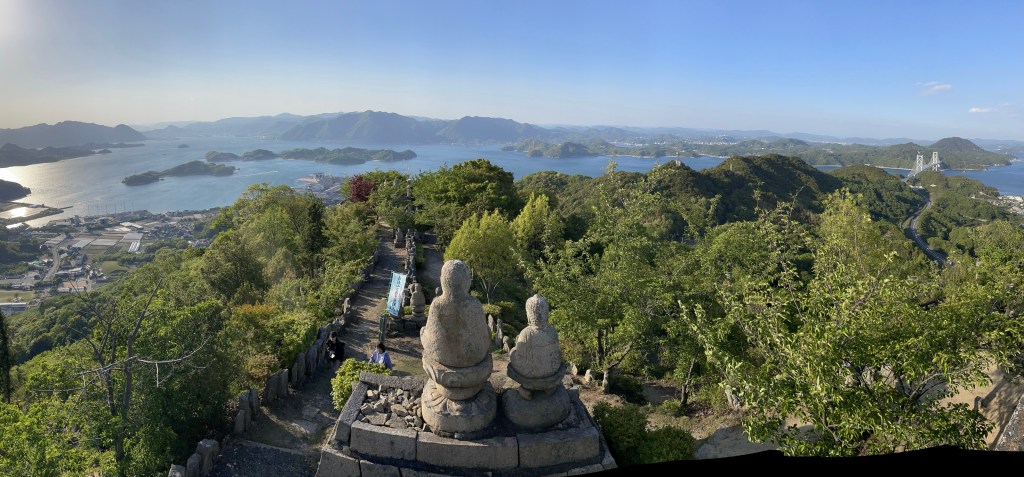
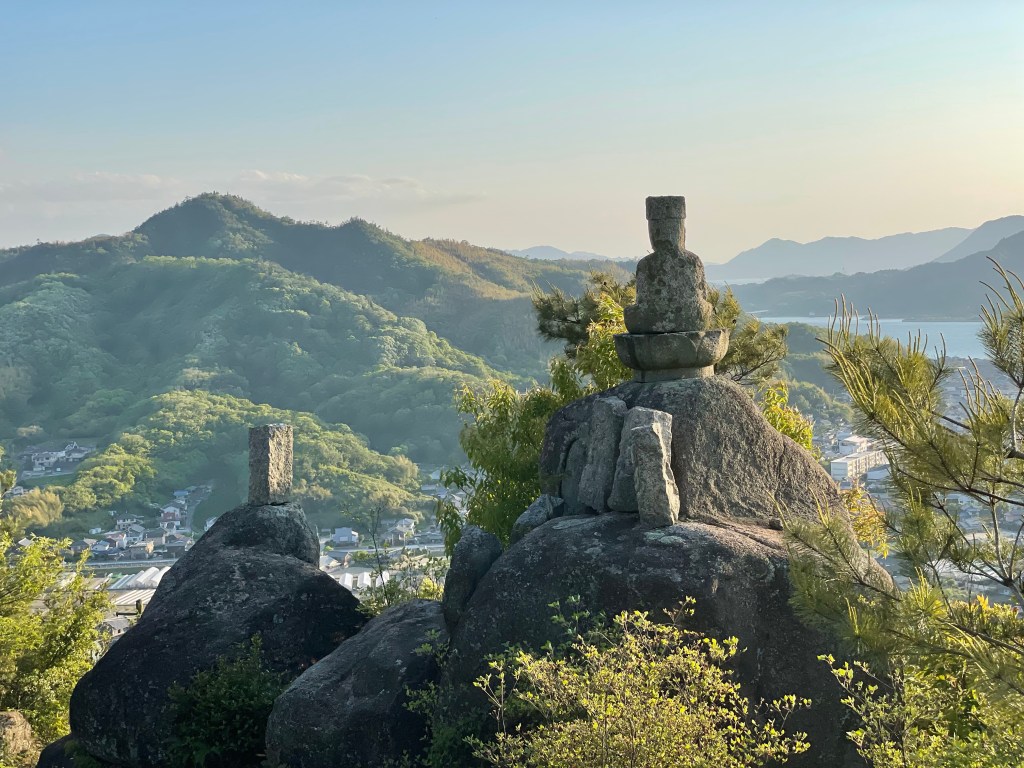
Saying goodbye to the statues was difficult, but paddle I did, and I camped on four consecutive nights on wild beaches and slept the fifth night in a hotel at Kure, not far from Hiroshima. The last half day was in the rain, which I enjoyed for the dreamy light and the paisley pattern of raindrops on the rolling ocean surface. I arrived, wet and cold at the hotel’s floating dock to enjoy Japanese civilization for two nights, while it rained incessantly. The paddling was often intense, against headwinds and currents, and then at times it was windless and smooth. A recurrent challenge was finding a way to get out of the kayak and onto a dock in order, for instance, to buy food. In one case I found a ferry dock, where three truck tires had been chained in vertical succession forming a ladder for me, but meant to be a bumper for big boats. This part of the Seto Sea is replete with islands, making for stunning scenery and excuses to stop, for instance to bathe in an onsen spa with sea views. But where was I going? I let the boat guide me — as it turned out, to Miyajima, an island visited briefly 20 years before and famous for a Shinto shrine approached from the sea via a Torii gateway. I worked hard against headwinds, and arrived at high tide to paddle under this torii.
Depuis les statues de Bouddha sur le mont Shiratake jusqu’au torii de Miyajima
Dire au revoir aux statues était difficile, mais j’ai pagayé et j’ai campé quatre nuits consécutives sur des plages sauvages, et j’ai dormi la cinquième nuit dans un hôtel à Kure, non loin d’Hiroshima. La dernière demi-journée a été sous la pluie, ce que j’ai apprécié pour la belle lumière et le motif paisley de gouttes de pluie sur la surface de l’océan. Je suis arrivé, mouillé et froid au quai flottant de l’hôtel pour profiter de la civilisation japonaise, alors qu’il pleuvait sans cesse pendant 36 heures. L’effort était souvent intense, contre des vents et des courants, puis parfois sans vent et lisse. Un défi récurrent était de trouver de sortir du kayak et de monter sur un quai, afin, par exemple, d’acheter de la nourriture. Dans un cas, j’ai trouvé un quai de ferry où trois pneus de camion avaient été enchaînés en succession verticale formant une échelle pour moi, mais destinés à être un pare-chocs pour les grands bateaux. Cette partie de la mer de Seto regorge d’îles, ce qui en fait des paysages magnifiques et des excuses pour s’arrêter, par exemple pour se baigner dans un spa onsen avec vue sur la mer. Mais où est-ce que j’allais ? J’ai laissé le bateau me guider – il s’est avéré, à Miyajima, une île visitée brièvement 20 ans au paravent et célèbre pour un sanctuaire shintoïste approché par la mer sous une porte torii. J’ai travaillé dur contre les vents contraires, et nous sommes arrivés à marée haute, comme voulu, afin de pagayer sous ce torii iconique.
No high tide worries here Isthmus camp
Hands after rain paddle. Raynaud syndrome. Machine confronts human
I paddled west for three full days, camping on isolated beaches under favorable conditions, but ending in the rain in a commercial campground, and then the last two nights were in Japanese inns. The last two half days have been challenging, because of headwinds. I am now high up on the island of Innoshima at the physical and spiritual summit of my kayak pilgrimage to revisit places discovered with Becky 11 years ago by bicycle.
J’ai pagayé vers l’ouest pendant trois jours complets, en campant sur des plages isolées dans des conditions favorables, mais en terminant sous la pluie dans un terrain de camping commercial, puis les deux dernières nuits ont été dans des auberges japonaises. Les deux dernières demi-journées ont été difficiles, en raison des vents contraires. Je suis maintenant haut sur l’île d’Innoshima au sommet physique et spirituel de mon pèlerinage en kayak pour revisiter les lieux découverts avec Becky il y a 11 ans en vélo.
Sounds of a busy place Heard from high Long may you resonate One more time, goodbye
I contoured teshima, and passed the northern tip of Naoshima, the island known for art installations. I discovered an industrial installation on this northern tip, processing a mountain of coal. I continued westward through a zone of heavy industry and air pollution. In the late afternoon I found myself fighting an incoming tide in front of a factory, which was putting out effluent into the sea. I managed to get through it all to stop on a small beach and reserve at an onsen (spa) hotel, which turned out to be a gem. I stayed three nights. I had a wide view of the sea and the beach below me where the 10 year old school students were being taught the crafts of the sea, including rowing and taking care of nets. They were learning to work together in Japanese groups.
J’ai contourné teshima et j’ai passé la pointe nord de Naoshima, l’île connue pour ses installations artistiques. J’ai découvert une installation industrielle sur cette pointe nord, traitant une montagne de charbon. J’ai continué vers l’ouest à travers une zone d’industrie lourde et de pollution atmosphérique. En fin d’après-midi, je me suis retrouvé à lutter contre une marée qui arrivait devant une usine, qui jetait des effluents dans la mer. J’ai réussi à traverser tout cela pour m’arrêter sur une petite plage et réserver dans un hôtel onsen (spa), qui s’est avéré être un joyau. Je suis resté trois nuits. J’avais une large vue sur la mer et la plage en dessous de moi où les élèves de 10 ans apprenaient l’artisanat de la mer, y compris l’aviron et l’entretien des filets. Ils apprenaient à travailler ensemble en groupes japonais.
Outdoor hot spring bathIndoor bathMy roomLunch Room view
Elementary school education in marine crafts. Many paddle strokes: 220 km
As I paddled the few kilometers to Tashima, I realized that the visit to the Ritsurin Gardens had been the first stop in my pilgrimage, and that second was about to be the Archives du Cœur, and art installation by Christian Boltanski, that we visited in 2012 as part of a most memorable day on Tashima, cycling through the mist and light rain. We decided not to record our heartbeats then, and I was glad that we had not, but I was very happy to find the small building busy with visitors when I arrived by kayak. I left the kayak at the nearby port, and climbed the trail up the hill to the next site in my pilgrimage, the Teshima Art Museum, which is not a museum at all, but rather a piece of sculpture and an installation by artist Rei Naito and architect Ryue Nishizawa. I spent the afternoon inside outside and around this monumental piece, which cannot be described, but which inspired me as much or more than it had in 2012. I spent the night camped on the beach in front of Les Archives du Cœur.
Alors que je pagayais les quelques kilomètres jusqu’à Tashima, je me suis rendu compte que la visite des jardins de Ritsurin avait été le premier arrêt de mon pèlerinage, et que ce deuxième était sur le point d’être les Archives du Cœur, l’installation d’art de Christian Boltanski, que nous avions visitée en vélo en 2012 sous un temps maussade et humide. Nous avons décidé de ne pas enregistrer nos battements de cœur à ce moment-là, et j’étais heureux que nous ne l’ayons pas fait, mais j’étais très content de trouver le petit bâtiment occupé par les visiteurs quand je suis arrivé en kayak. J’ai laissé le bateau dans le port voisin, et j’ai gravi le sentier de la colline jusqu’au troisième site de mon pèlerinage, le musée d’art de Teshima, qui n’est pas du tout un musée, mais plutôt une sculpture et une installation par l’artiste Rei Naito et l’architecte Ryue Nishizawa. J’ai passé l’après-midi à l’intérieur, à l’extérieur et autour de cette pièce monumentale, qui ne peut pas être décrite, mais qui m’a inspiré autant ou plus qu’en 2012. J’ai passé la nuit à camper sur la plage en devant les Archives du Cœur.
Arrival at the Archives du Cœur, Teshima Island Les Archives du Cœur View from inside Arrival Teshima Art Museum An icon from the past
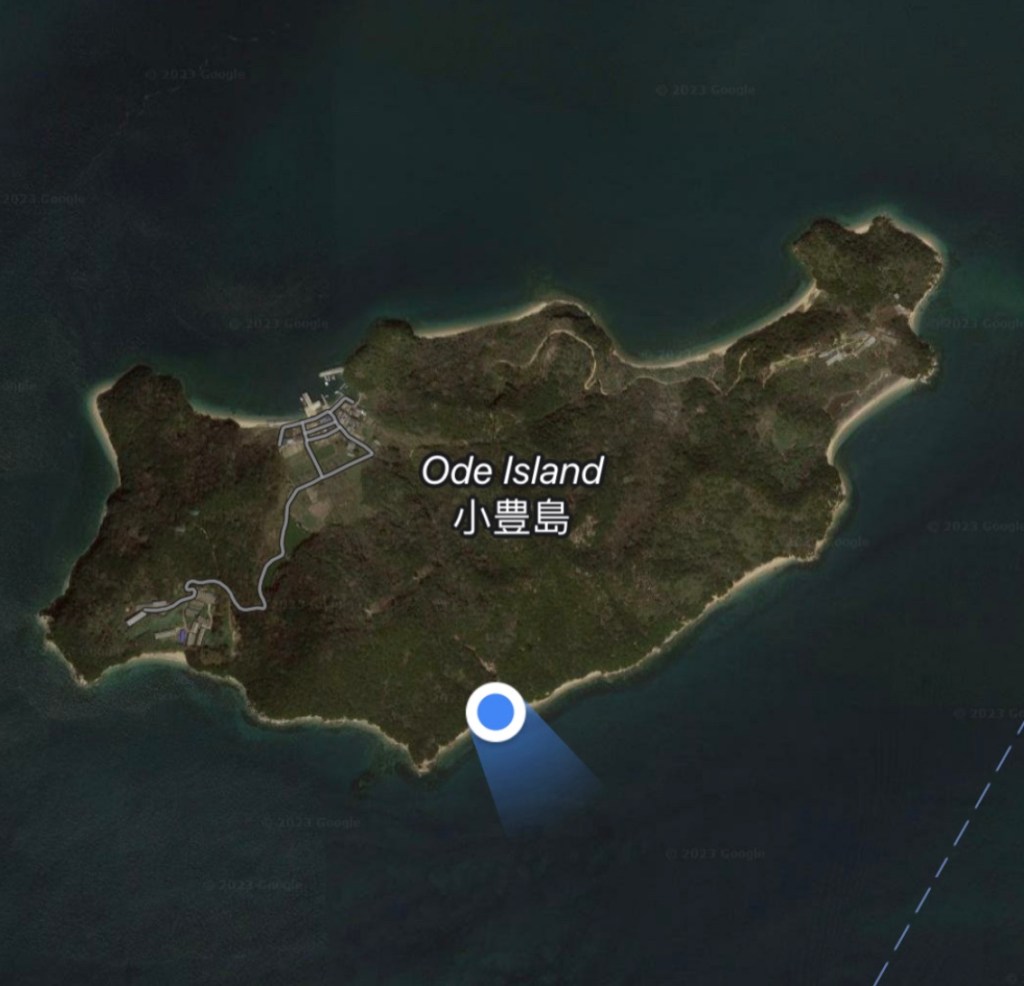
I paddled northwest from the town of Shido on Shikoku, toward the art island of Teshima, which meant crossing the Seto Sea shipping lanes. All went well, except for the last hour, when a strong head wind prevented me from getting to Tashima. I barely managed to land on a small island, Ode, adjacent to Teshima, but the effort to get there was maximal. However, the free camping was ideal. Thankfully, I was not blown back into the shipping lanes.
J’ai pagayé au nord-ouest de Shikoku, en direction de l’île d’art de Teshima, ce qui signifiait traverser les couloirs de navigation de la mer de Seto. Tout s’est bien passé, sauf la dernière heure, quand un fort vent de face m’a empêché d’arriver à Tashima. J’ai à peine réussi à atterrir sur une petite île, Ode, adjacente à Teshima, mais l’effort pour y arriver était maximal. Cependant, le camping sauvage était idéal. Heureusement, je n’ai pas été repoussé dans les couloirs de navigation.
Goodbye Shikoku, hello Teshima (Ode)Just through the shipping lanes with Ode island to the north
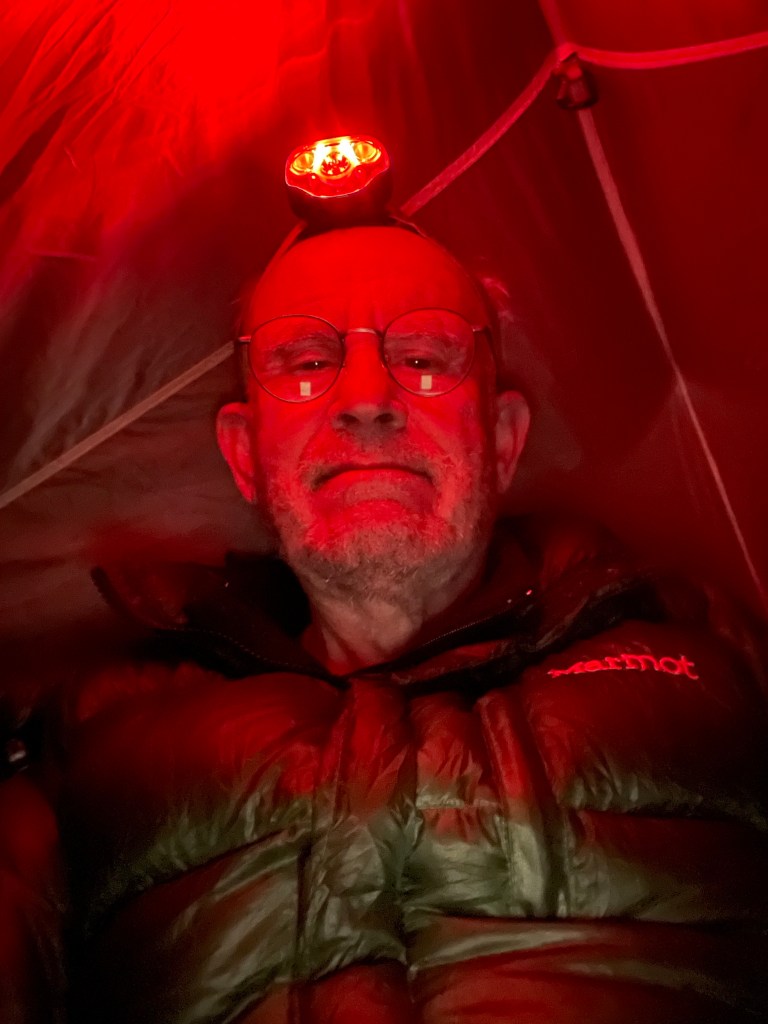
Camp position on Ode IslandShodoshima ferry passing at dusk, as described in the novel, Shikoku.Red light tenting after delicious dinner of peanuts and dried fishSand camp on Ode Island
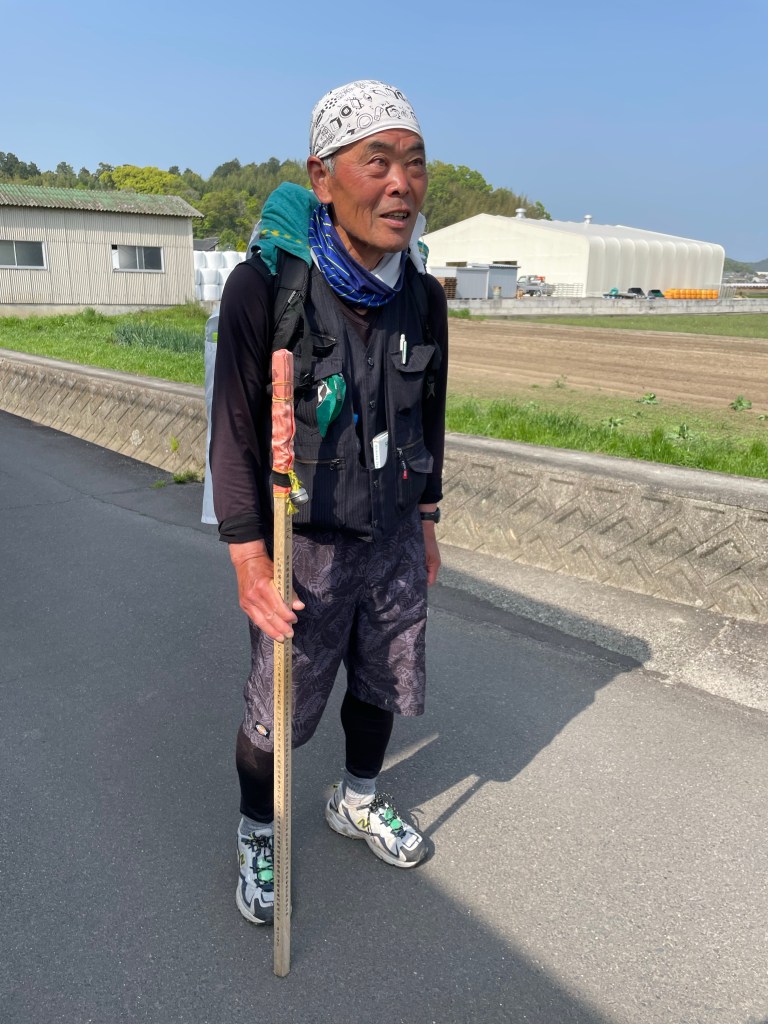
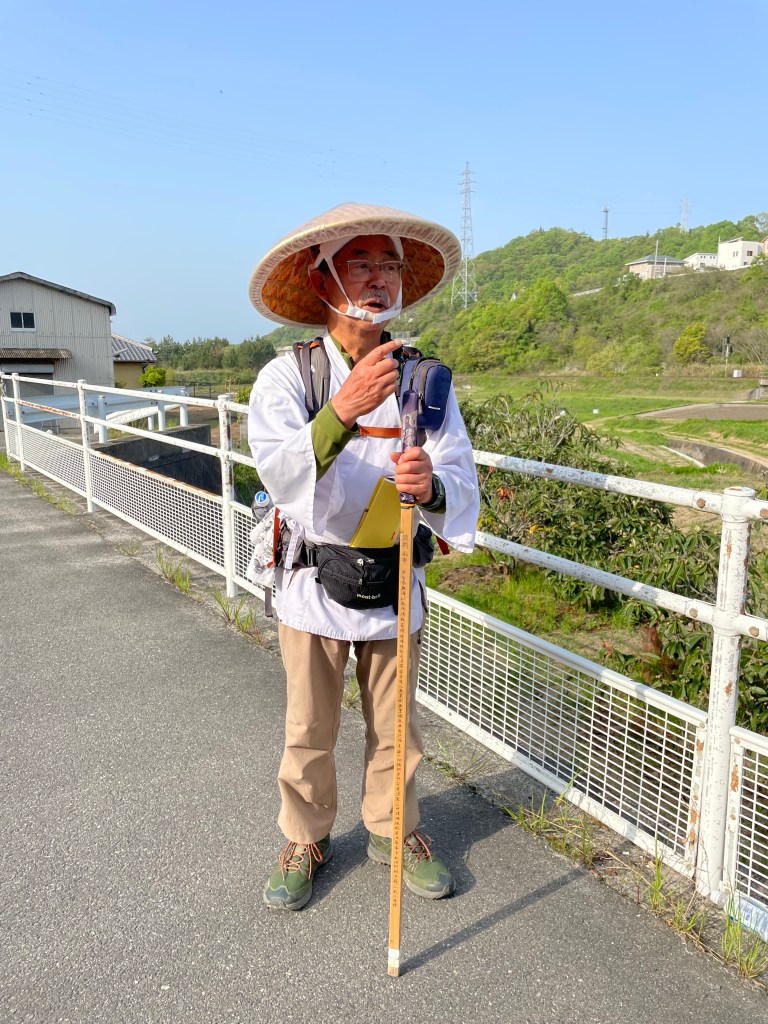
The second and the third of the off water days brought rest and encouragement. When I arrived at Fujiyama the hostess asked me if I was a pilgrim,. I said no, but realized later that she was right. The Ryocan was only a few hundred meters from the 86th Buddhist temple in the 88 temple pilgrimage. A man of about my age explained in good English that he had just finished the 88 Temple pilgrimage on foot, and that he had taken 50 days to do the 1200 km hike. I visited temple 86 with two Australian ladies met by happy chance on the way. We hiked to temple 87 and back: 14 km in my boating slippers. We encountered many pilgrims and visited several Shinto shrines, ending with dinner to celebrate their completion of one month of pilgrimage trekking.
.
Le deuxième et le troisième des jours hors de l’eau ont apporté du repos et des encouragements. Quand je suis arrivé à Fujiyama, l’hôtesse m’a demandé si j’étais un pèlerin. J’ai dit non, mais je me suis rendu compte plus tard qu’elle avait raison. Le Ryocan n’était qu’à quelques centaines de mètres du 86e temple bouddhiste dans le pèlerinage des 88 temples. Un homme de mon âge a expliqué en bon anglais qu’il venait de terminer le pèlerinage complet à pied, et qu’il avait pris 50 jours pour faire la randonnée de 1200 km. J’ai visité le temple 86 avec deux dames australiennes rencontrées par chance sur le chemin. Nous avons fait de la randonnée jusqu’au temple 87 et le retour : 14 km dans mes pantoufles de bateau. Nous avons rencontré de nombreux pèlerins et nous avons visité plusieurs sanctuaires shintoïstes, suivi par un dîner pour célébrer leur achèvement d’un mois de pèlerinage.
Temple, 87
A pilgrim nearing the end of the 88 temple pilgrimage.
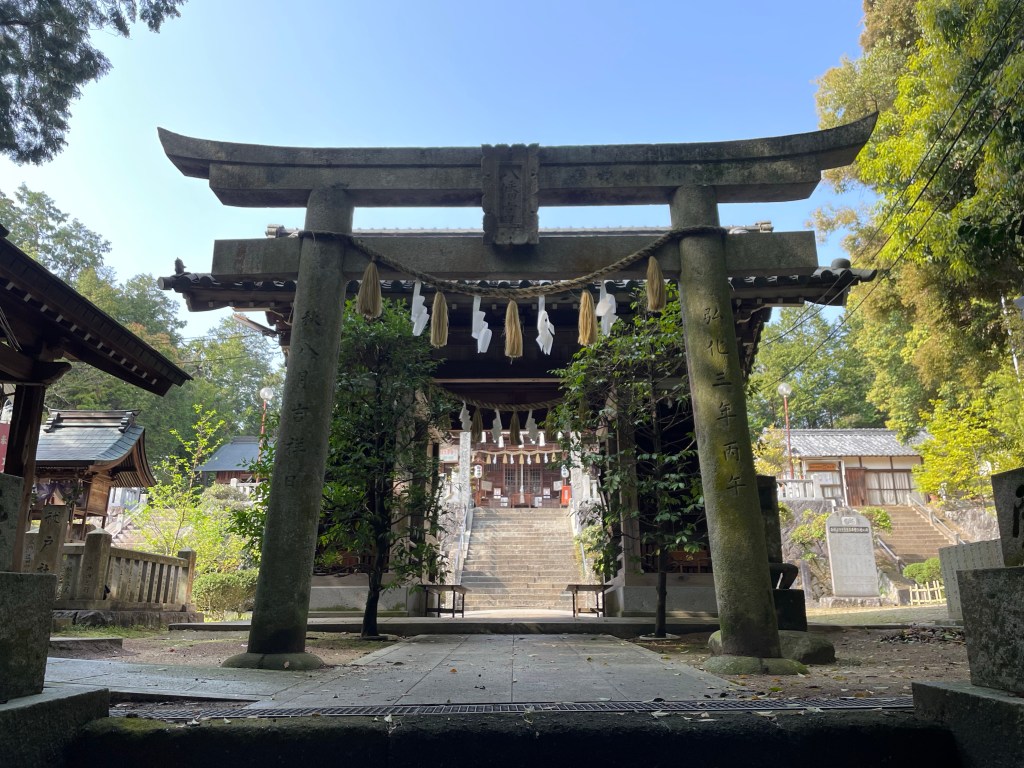
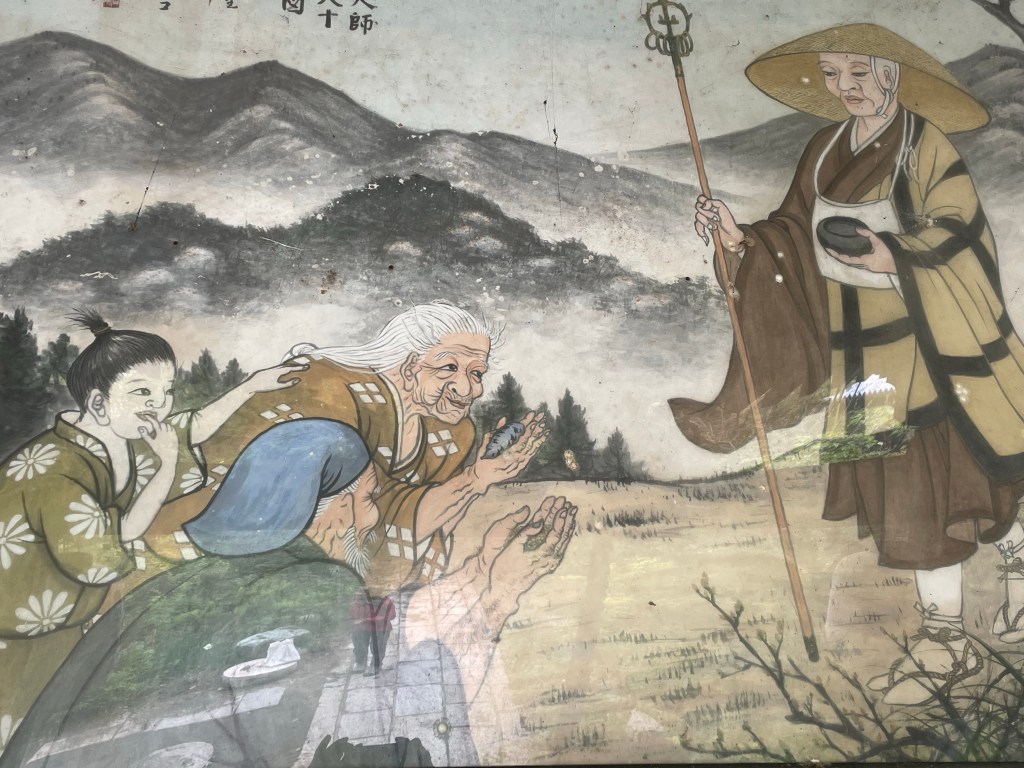
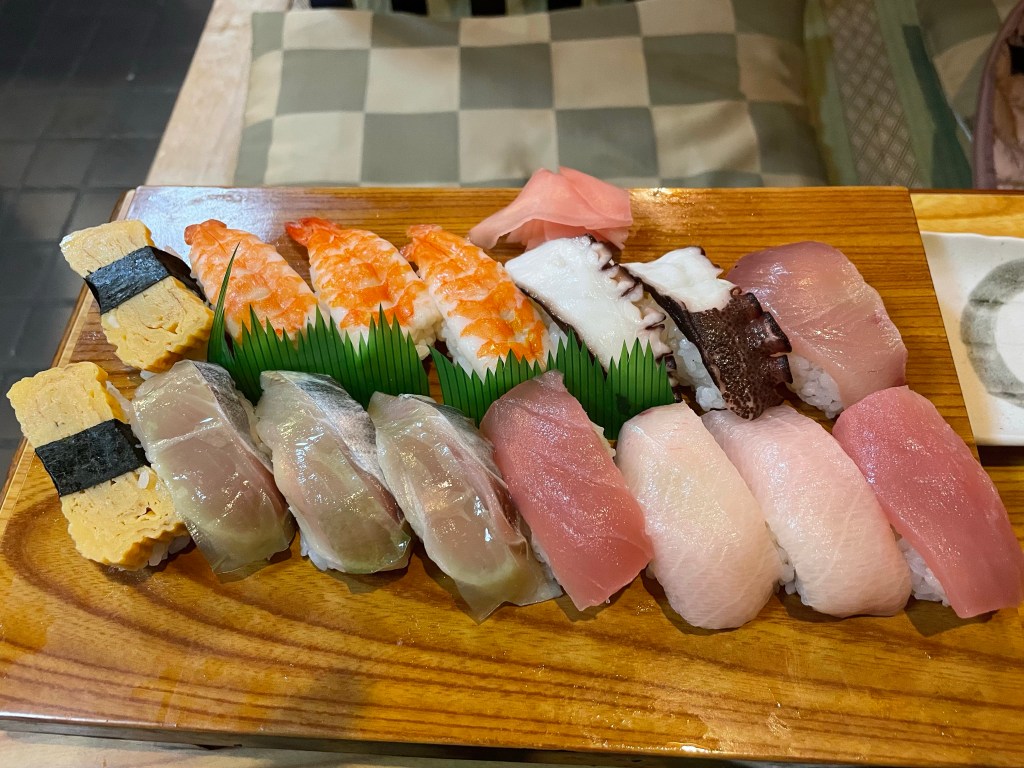
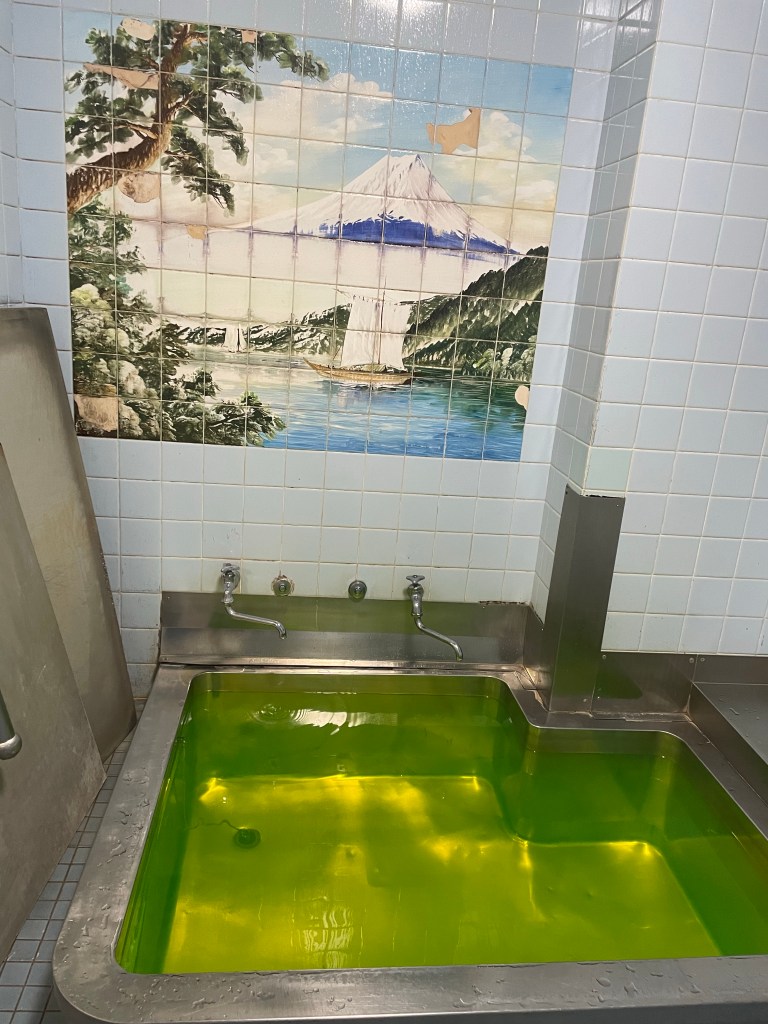
Entrance to Zeta-hachimangu Shinto shrine Painting in temple 86: Kobo Daishi was the original pilgrim and founder of the 88 temples about 900 ADLooking into the sanctuary at Nagao-ji, temple 87Fujya Ryocan with Teresa and JackieThe sashimi course at Ryocan Fujya Sushi courseBath in Ryocan Fujya
Day three on land begin with a visit to the dental clinic across the street. Aided by Google Translate and after an x-ray, I learned that there was no danger of infection in the broken molar. I thus happily set out by train to Takamatsu to visit the Ritsurin Gardens, which had left a strong feeling of wonderment after the visit with Becky in 2012 (described in the novel Shikoku). This time was equally moving. I took my time over a matcha in the tea house by the pond in the south garden.
Le troisième jour sur terre a commencé par une visite à la clinique dentaire de l’autre côté de la rue. Aidé par Google Translate et après une radiographie, j’ai appris qu’il n’y avait aucun risque d’infection dans la molaire cassée. Je suis donc heureusement parti en train pour Takamatsu pour visiter les jardins de Ritsurin, qui avaient laissé un fort sentiment d’émerveillement après la visite avec Becky en 2012 (décrit dans le roman Shikoku). Cette fois-ci était tout aussi émouvante. J’ai pris mon temps en buvant un matcha dans la maison de thé au bord de l’étang dans le jardin sud.
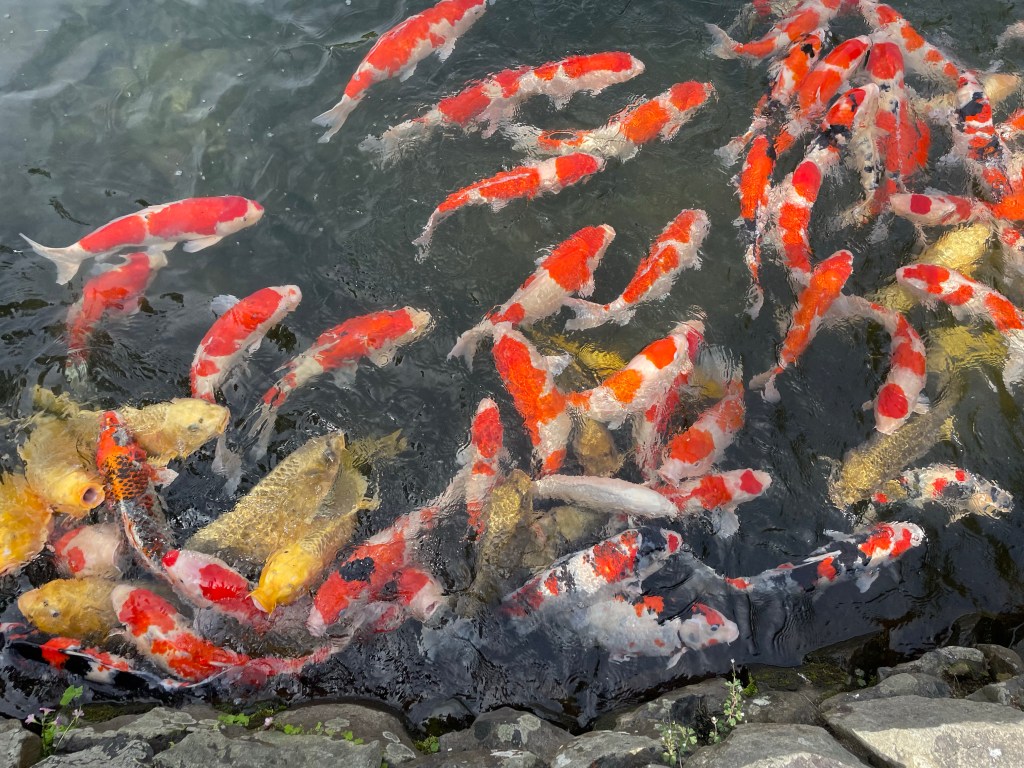
Koi carpe, south Ritsurin Garden
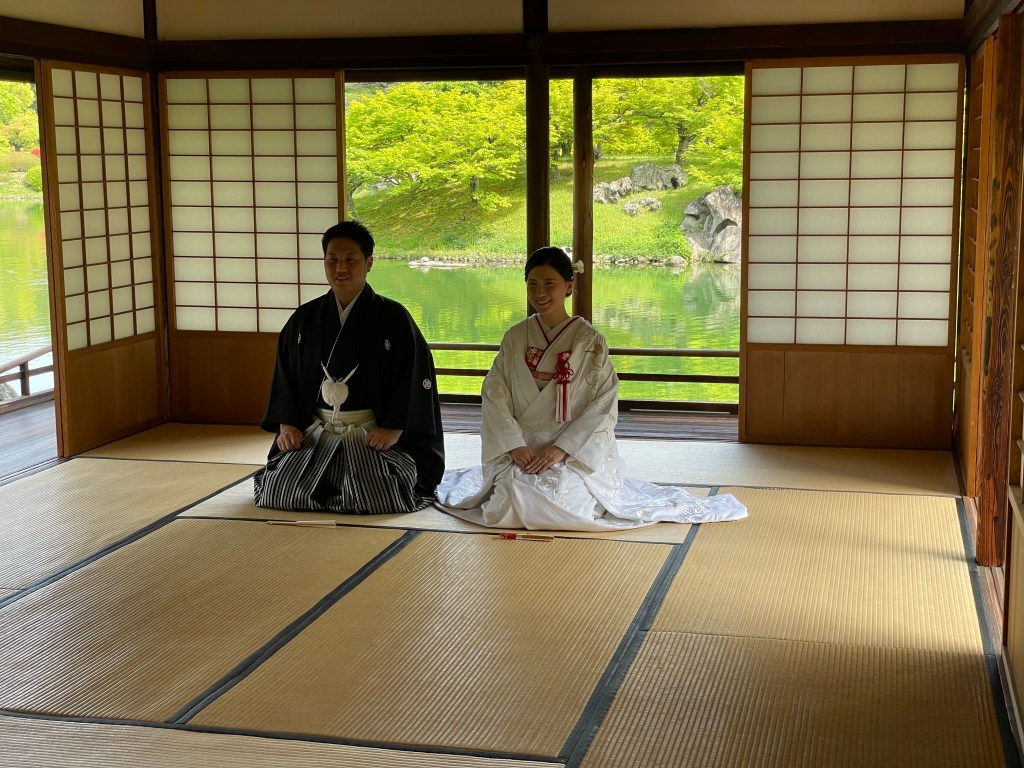
South Garden strollThe tea house in Ritsurin GardensWedding in the Ritsurin tea house, Takamatsu






































 David tepfer