
(Photos and videos are below the text.)
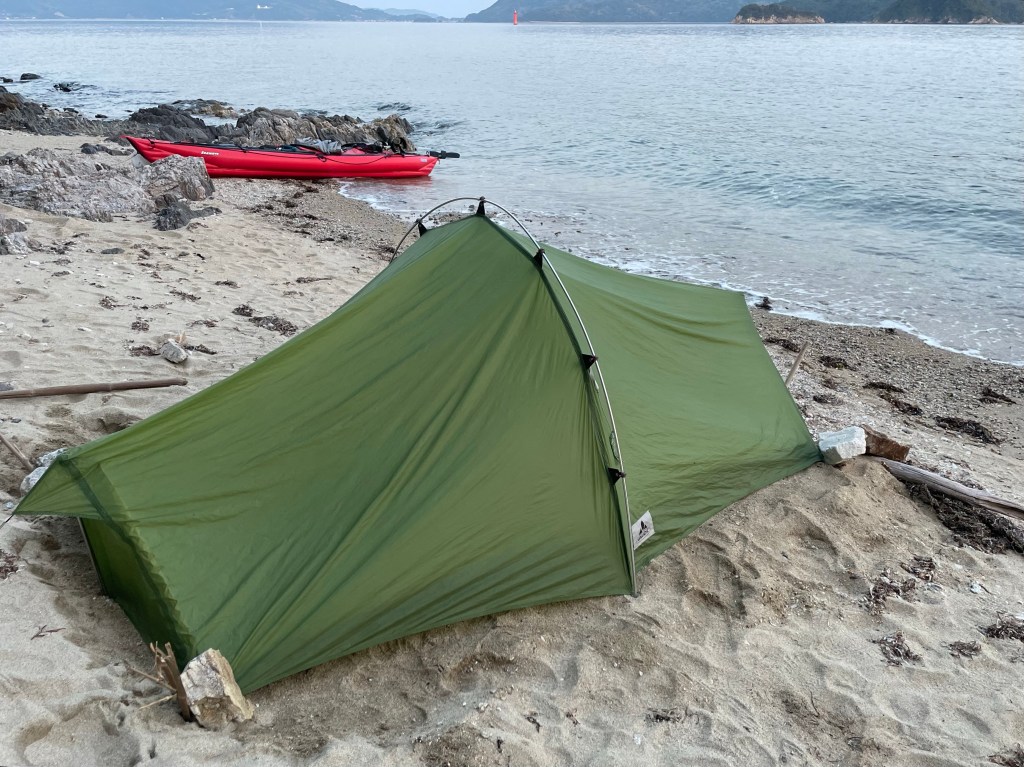
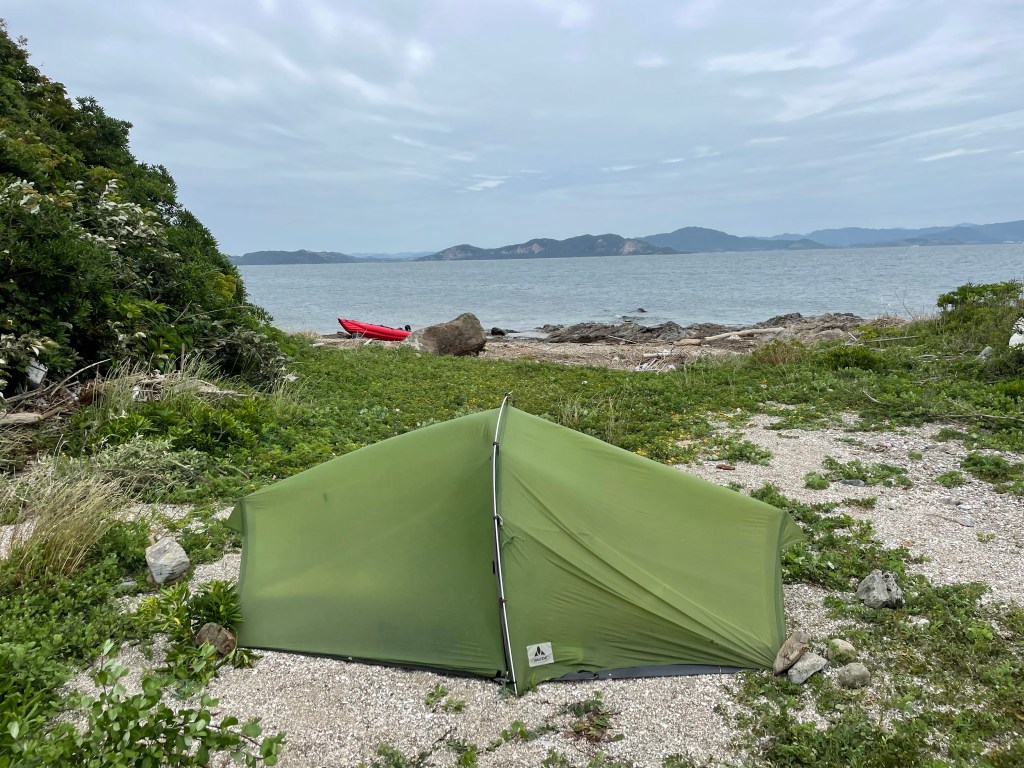
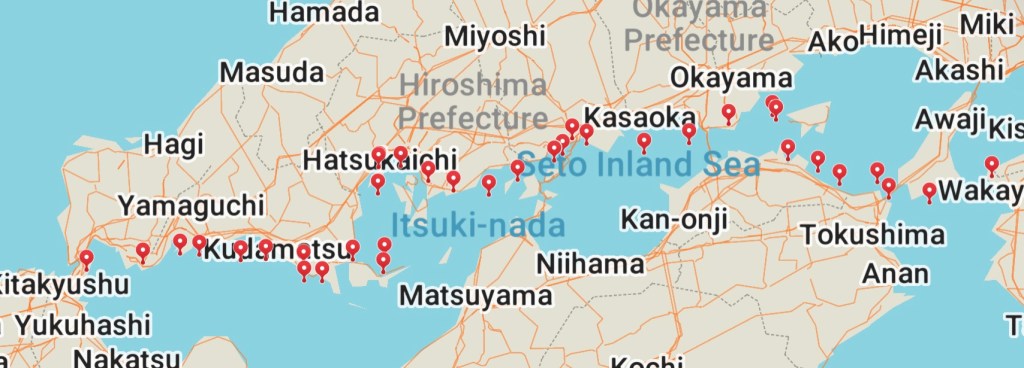
A day off in an official beach camp with new toilet facilities and views west and east! I’m adjacent to a fishing village on the island of No, just 75 km from my intended final destination of Kitakyushu. I have almost three weeks before returning to Paris, so time off on this island tempts… and the wind is too strong from the west to kayak farther. The camp site is free, and instead of sharpening sticks to drive into the sand, I used my tent stakes, pounded into flat, terra firma, three meters above the high tide level. In the last camp it took 40 minutes at dusk to carve out a flat place at the top of the beach, in the hope that the high tide would not flood me during the night. (It came within a few centimeters.) Here, there is nothing to worry about. The kayak is just below me on a shelf, also well above the high tide level. The beach is composed of small, flat stones, a welcome change from the fine sand that gets into everything.
The geology has changed. I’m at the western border of the Seto Sea National Park, at the end of my “islands everywhere” archipelago, with time to relax. I’ve just treated myself to a royal milk tea, hot from the vending machine in the village. Otherwise, it seems like there is nothing here, but a few fishing boats and elderly folks pushing carts, but nothing often hides something important. I think I’ll have another royal milk tea and further contemplate the meaning of nothing, but first, how about I look at this village?
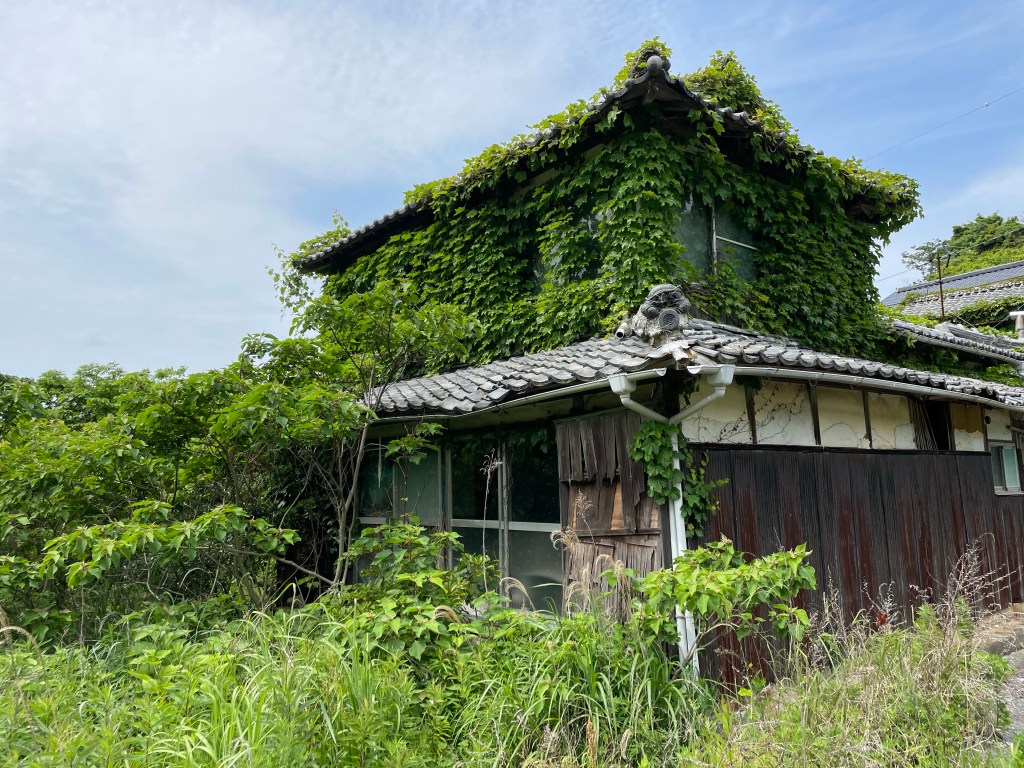
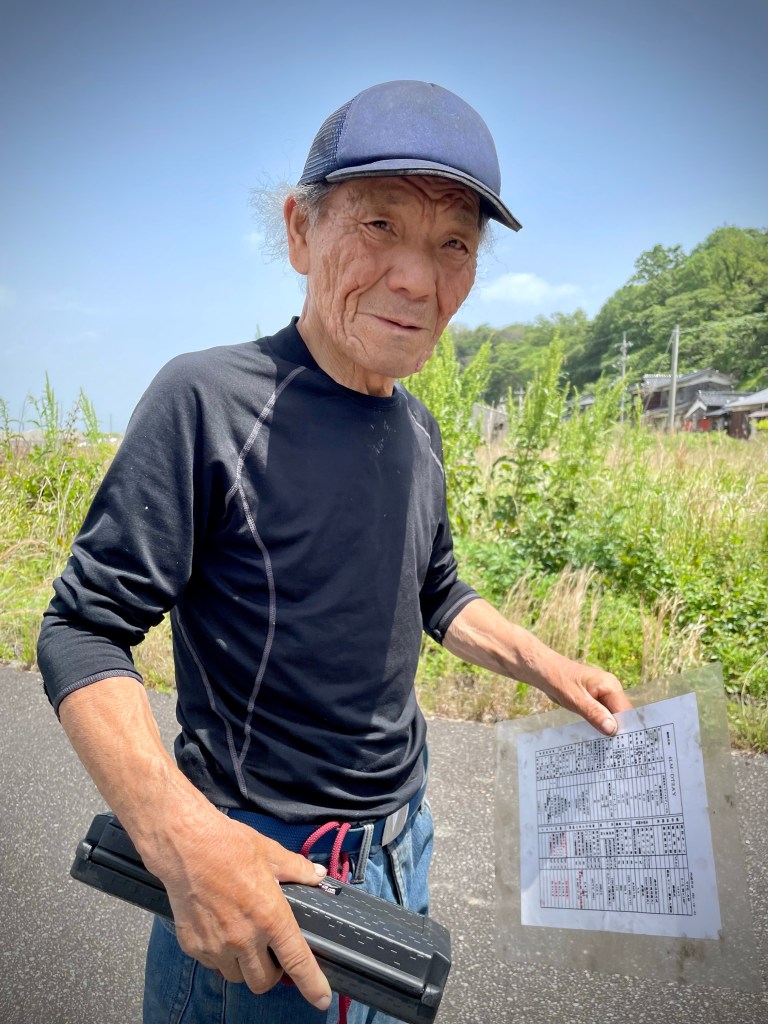
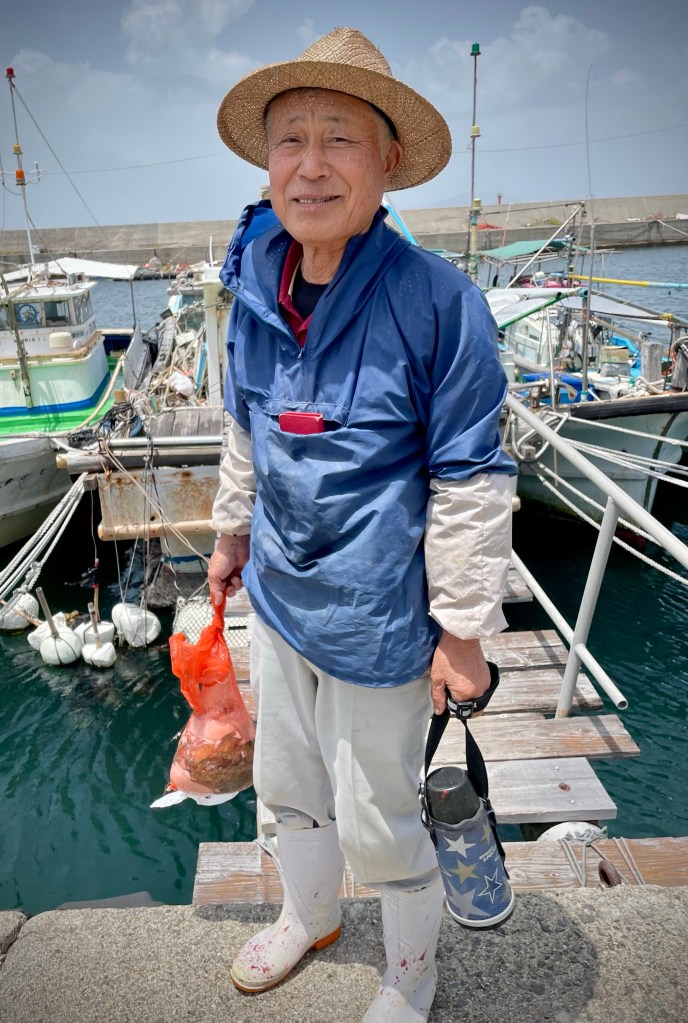
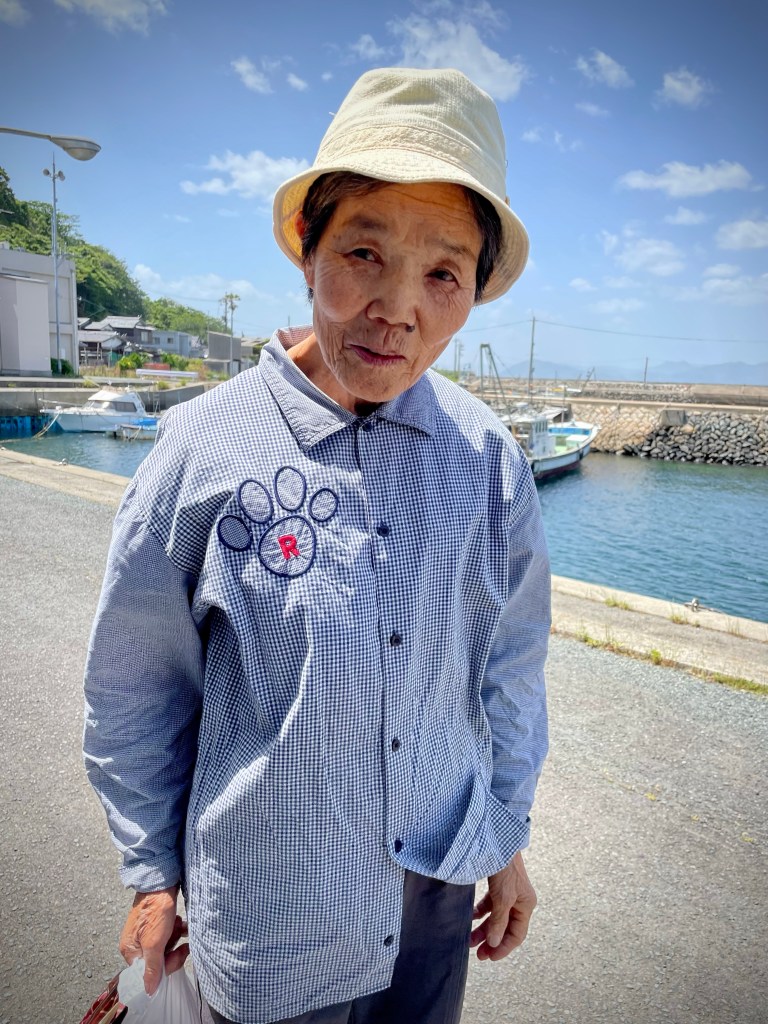
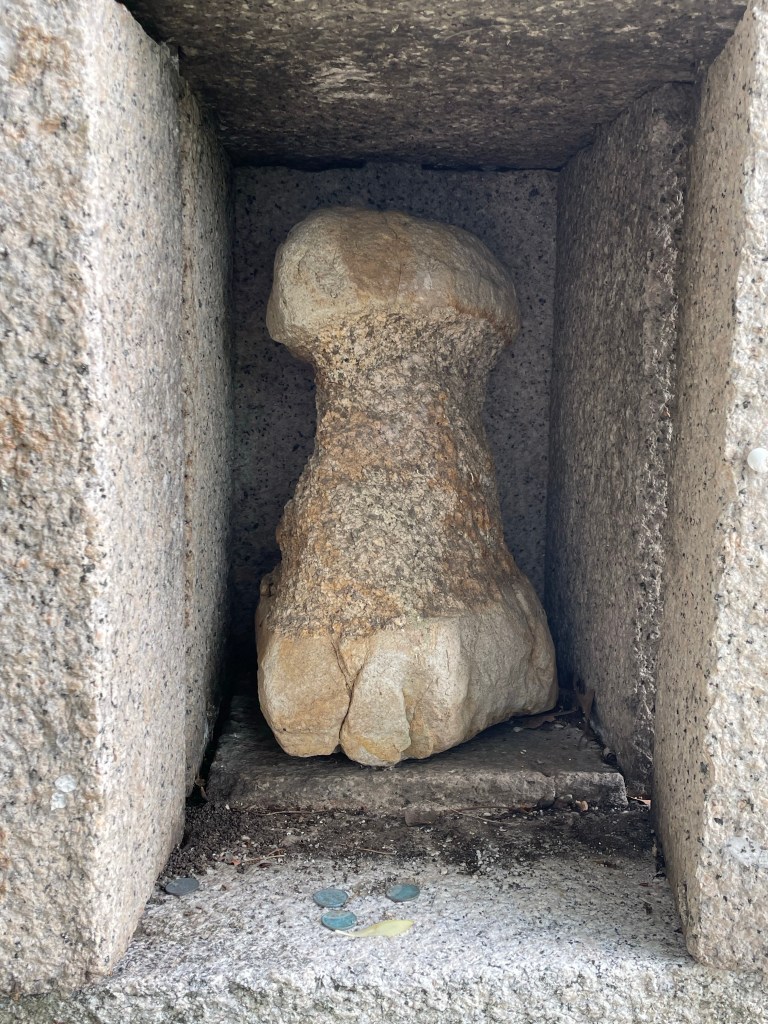
I found a community center, a school, a post office, a shop with a few basic supplies and a Buddhist Temple on the hill with a nice house by it, plus two Shinto shrines. But many of the houses in the village are abandoned. The windows are taped and boarded, and in some, vines have grown over the roofs and even inside the windows. The lady at the community center told me that there are nevertheless 60 people living here. The ferry from the mainland just arrived, and about 10 people got off. Some carried the spoils of supermarket shopping, so this is almost a ghost town for commerce; houses are being repossessed by nature; and the elderly reign. A statue of Kannon, the Buddhist God of mercy, guards the port. She holds a fishing pole and a red snapper. Kannon is all seeing. (The Canon camera company is named after her.) Environmental change has weakened the fisheries. There are seven children in the school, and they all come by ferry each morning. Kannon is crying.
Getting here since my last post was hard work, but always stimulating for visual delights and mental challenges, like playing the “rising tide floats all tents” game at night and navigating the storms, currents and winds. After waiting out the rain chez Kazoo and Mayumi in their traditional house on Suo-Oshima Island, I paddled and paddled and paddled, camping three nights under the stars, until another storm drove me to shelter in an onsen hotel, which had a natural hot spring with mild minerals that left a silkiness on my skin. The food was exceptional and the contrast between bivouacking and hotelling was deliciously decadent. The hotel was above the town and all the rooms and the public bath had splendid sea views.
One of the camps, on Sagojima, was on a perfect beach, chosen to be above the tide with an eastern exposure to the morning sun. However, it will be remembered not for this perfection, but rather for a scary incident. These islands are covered with dense jungle. As I was collecting sticks and rocks close to this foliage to secure the tent, my wilderness idyll was interrupted by a very near, loud, almost human cry, followed by a grown, a moan and then a guttural grunt. I froze as the adrenaline flowed. The hair on my head and neck went erect. I jumped back and grabbed a bamboo pole, fumbled for my pocket knife and prepared to flee in the kayak. But then I heard a familiar snort. The animal, just a couple meters away, was surely a wild boar, a species I know from France and other places in Japan. Relief! The adrenaline was quickly replaced by laughter. Boar are nocturnal pigs with tusks, and this one was probably having a bad dream. I slept well that night, with fireflies dancing, knowing that boar don’t attack humans, but ironically, they do in my second novel, Serendipity, which is the follow up to Shikoku, available in English, French and Japanese, and the first in the series of four, with three more to publish.
I’ve now spent a second day on No Island, because strong headwinds winds have made it impossible to kayak westward. There is much to see and try to understand here, and the man in the shop just invited me to his house for dinner!
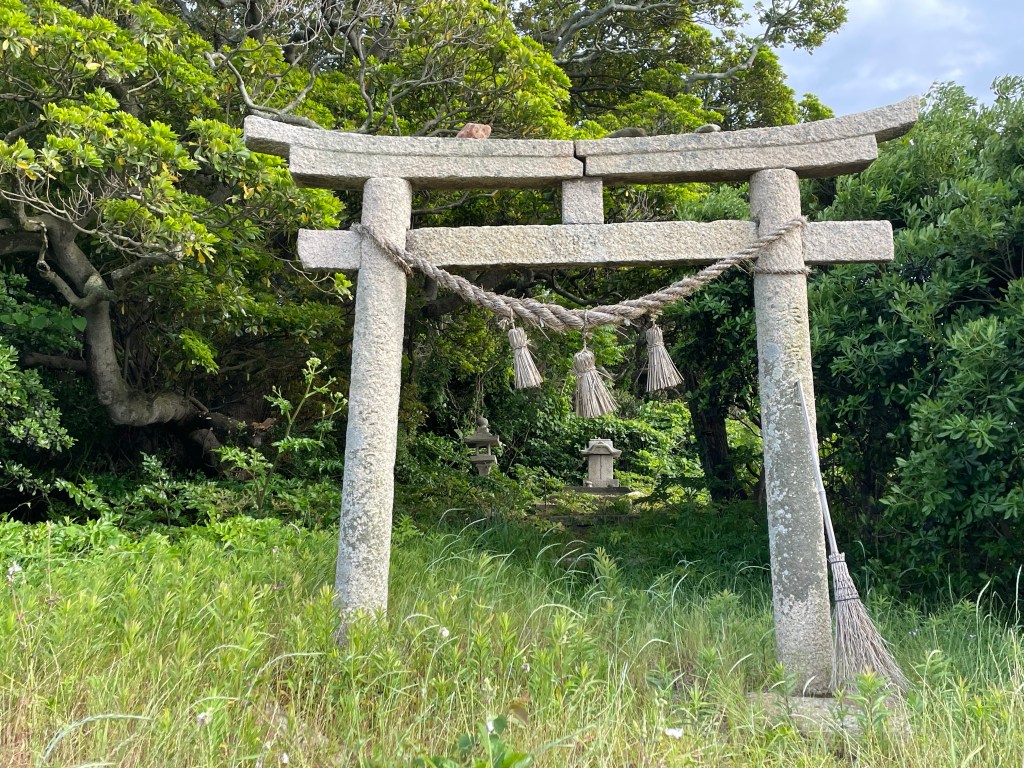
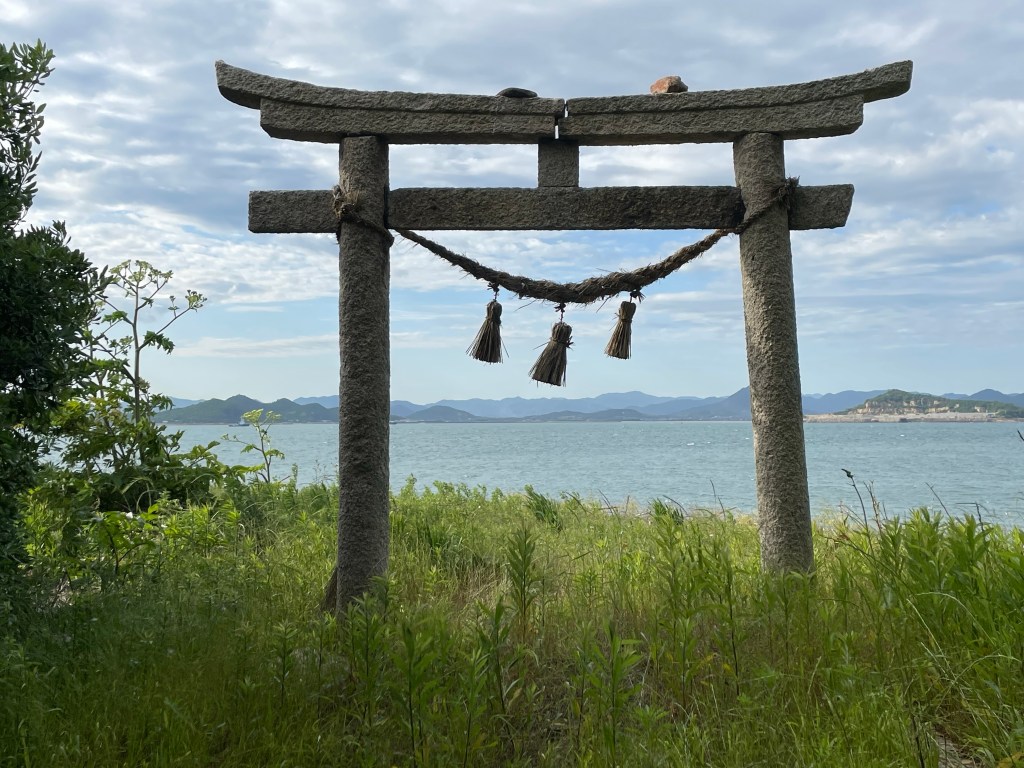
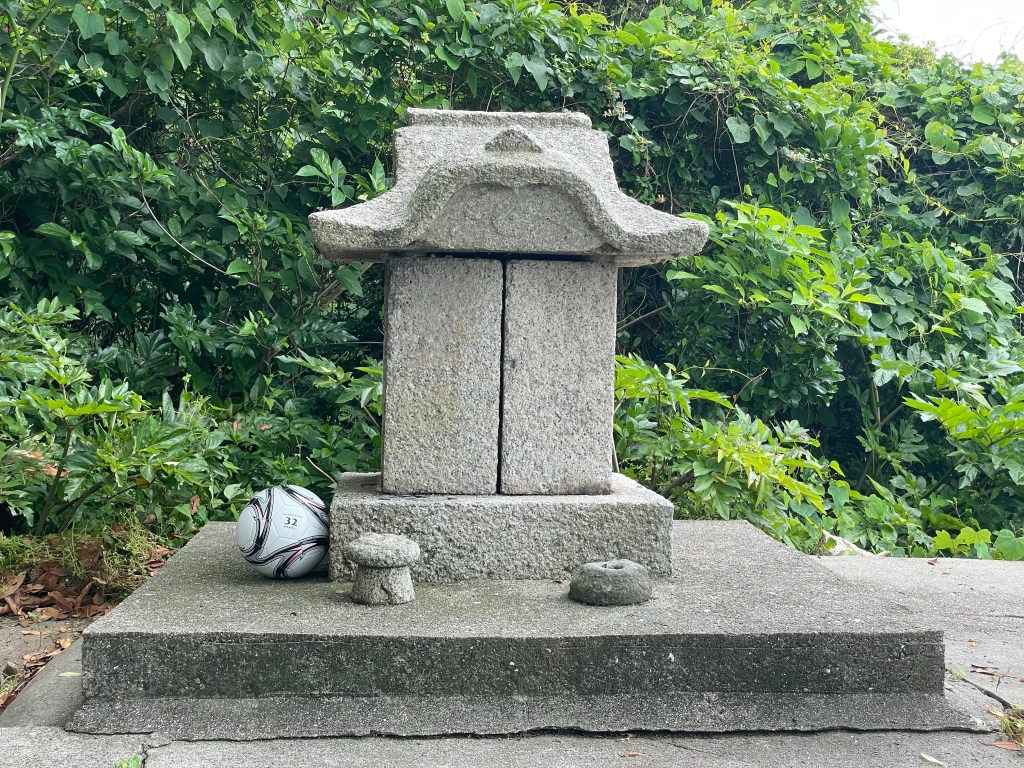
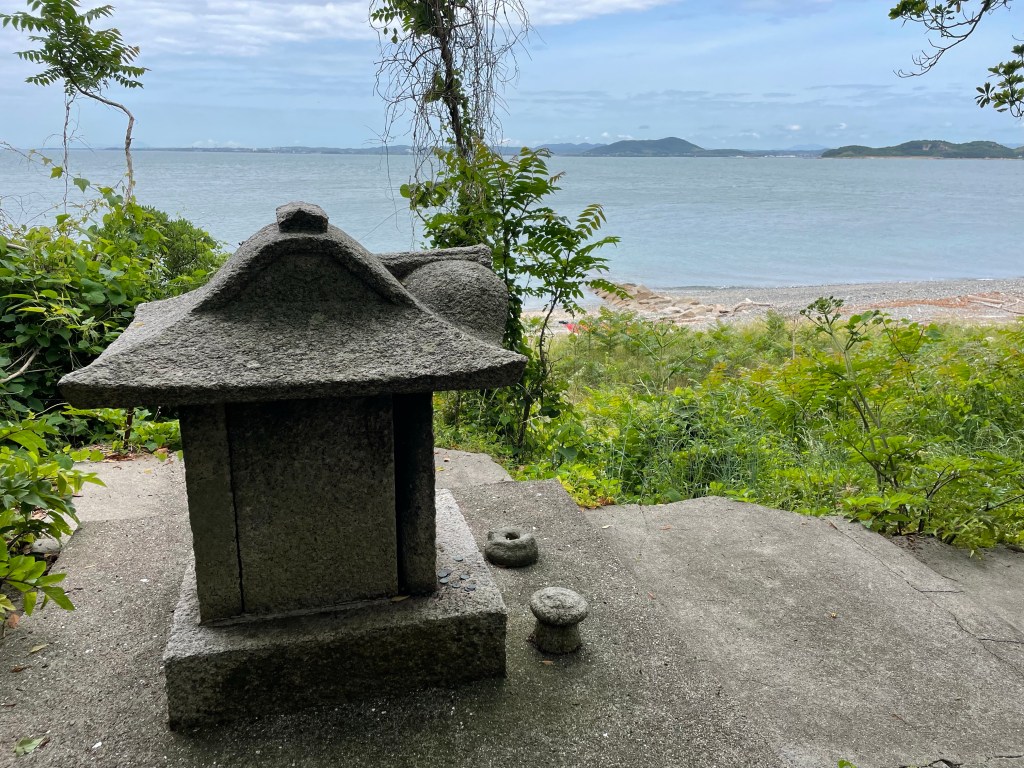
The dinner with Kazue and Ichikawa was a delicious departure from my diet of dried fish and peanuts, and thanks to our telephones’ simultaneous translations, I got to know them and learn more about the village, where they have lived for 30 years, experiencing the decline in the fishing business and the aging of the population. I next paddled over six hours, nonstop, to Saba Island, much of it against head winds, but the effort was worth it for the perfect campsite and the climb to lighthouse above. Takeshima was next, but this time I was helped by a tailwind and large waves pushing me forward. I camped near the Shinto shrine, a simple and exceptionally beautiful piece of peace. I found a traditional bamboo broom on the beach in good condition and spent part of the morning cleaning the shrine of leaves and removing plants growing in the cracks. I also found a new soccer ball on the beach and left it as an offering, along with a ¥500 coin. I hope the Goddess finds someone to play with. These were my last islands. Both of them are exceptionally small, uninhabited and unusually beautiful. I could have used a week on each one.
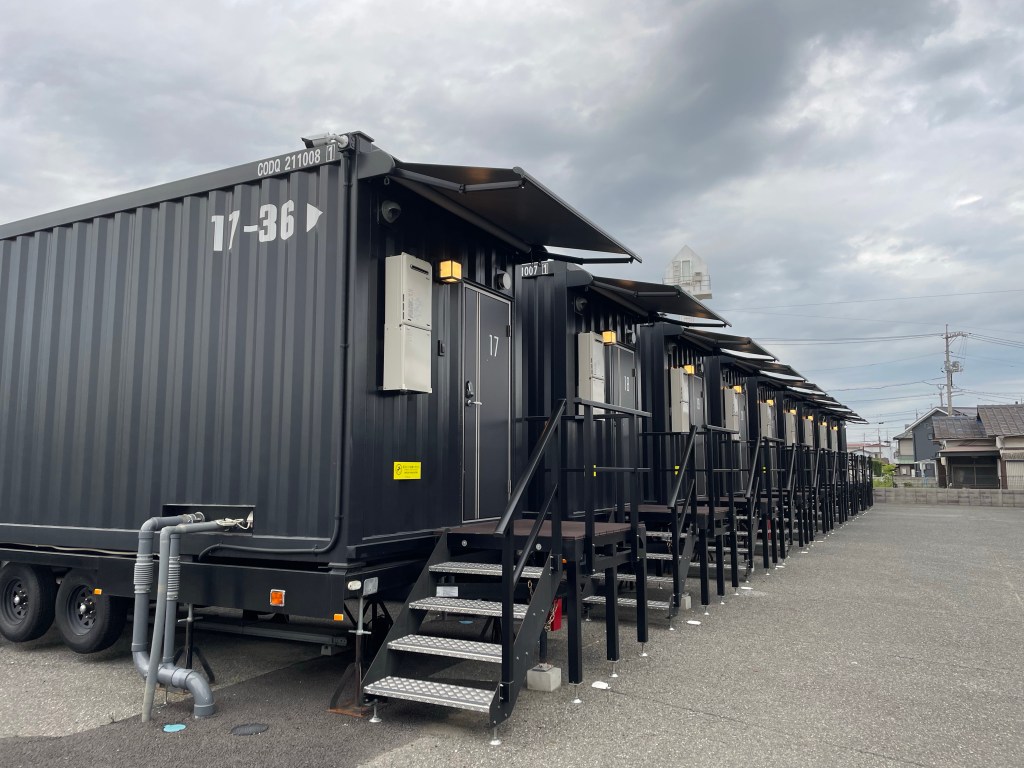
I next made it to the city of Ube with a strong wind and waves helping me. For a little contrast, I’m staying in a container hotel. Each room is a shipping container. Tomorrow I’ll cross to the big island of Kyushu, which was my originally intended, final destination. But who knows? Maybe the wind will push me all the way to Busan, South Korea. There’s a typhoon not far to the south that could provide the necessary adrenaline.
———-
Une journée de repos dans un camping officiel avec de nouvelles sanitaires et une vue sur l’ouest et l’est ! Je suis à côté d’un village de pêcheurs sur l’île de No, à seulement 75 km de ma destination finale prévue, Kitakyushu. J’ai presque trois semaines avant de retourner à Paris, donc du temps libre sur cette île me tente… et le vent de l’ouest est trop fort pour continuer. Le terrain de camping est gratuit, et au lieu d’improviser des piquets de tente avec des bouts de bois enfoncés dans le sable, j’ai utilisé mes vrais piquets de tente, sur terra firma, à trois mètres au-dessus du niveau de la marée haute. Dans le dernier camp, il a fallu 40 minutes au crépuscule pour sculpter un endroit plat au sommet de la plage, dans l’espoir que la marée haute ne m’inonderait pas pendant la nuit. (L’eau est monté à quelques centimètres de mon platform.) Ici, il n’y a rien à craindre. Le kayak est juste en dessous de moi, bien au-dessus du niveau de la marée haute. La plage est composée de petites pierres plates, un changement bienvenu par rapport au sable fin qui pénètre dans tout.
La géologie a changé. Je suis à la frontière ouest du Parc National de la Mer de Seto, au bout de mon archipel “îles partout”, avec du temps de me détendre. Je viens de m’ offrir un thé au lait royal, livré chaud du distributeur automatique du village. Sinon, il semble qu’il n’y ait rien ici, juste quelques bateaux de pêche et des personnes âgées qui poussent des charrettes, mais “rien” cache souvent quelque chose d’important. Je pense que je vais prendre un deuxième thé et réfléchir davantage au sens du “rien”, après avoir exploré ce village.
J’ai trouvé un centre communautaire, une école, un bureau de poste, une boutique avec quelques fournitures de base et un temple bouddhiste sur la colline avec une belle maison à côté, et en plus, deux sanctuaires shintoïstes. Mais beaucoup de maisons du village sont abandonnées. Les fenêtres sont scellées et bordées, et dans certaines, les vignes ont poussé sur les toits et même à l’intérieur des fenêtres. La dame du bureau du gouvernement m’a dit qu’il y a néanmoins 60 personnes qui vivent ici. Le ferry vient d’arriver, et environ 10 personnes sont descendues. Certains portaient le butin des achats dans les supermarchés, c’est donc presque une ville fantôme pour le commerce ; les maisons sont reprises par la nature ; et les personnes âgées règnent. Une statue de Kannon, la déesse bouddhiste de la miséricorde, garde le port. Elle tient une canne à pêche et un poisson. Kannon voit tout. (La société d’appareils photo Canon porte son nom.) Mais les changements environnementaux d’origine humaine ont affaibli les pêches. Il y a sept enfants à l’école, et ils viennent tous en ferry chaque matin. Kannon pleure.
Arriver à l’isle de No depuis mon dernier compte rendu a été un défi physique et en même temps une joie pour les délices visuels et le plaisir de naviguer dans les tempêtes, les courants et les vents. Après avoir attendu la fin de la pluie chez Kazoo et Mayumi dans leur maison traditionnelle, j’ai pagayé, pagayé et pagayé, campant trois nuits sous les étoiles, jusqu’à ce qu’une autre tempête me conduise à l’abri dans un hôtel onsen, qui avait une source chaude naturelle avec des minéraux doux qui laissaient une soie sur ma peau. La nourriture était exceptionnelle et le contraste entre le bivouacking et l’hôtellerie était délicieusement décadent. L’hôtel était au-dessus de la ville et toutes les chambres et le bain public avaient une vue splendide sur la mer.
L’un des camps, sur Sagojima, se trouvait sur une plage parfaite, choisie pour être au-dessus de la marée avec une exposition orientale au soleil du matin. Cependant, je m’en souviendrai non pas pour cette perfection, mais plutôt pour un incident effrayant. Ces îles sont couvertes d’une jungle dense. Alors que je collectionnais des bâtons et des roches près de ce feuillage pour sécuriser la tente, mon idylle sauvage a été interrompue par un cri très proche, fort, presque humain, suivi d’un gémissement, puis d’un grognement guttural. J’ai sauté en arrière ; j’ai attrapé un bâton de bambou ; je me suis préparé à fuir dans le kayak. Et puis, j’ai entendu un reniflement familier. L’animal, à seulement quelques mètres de moi, était sûrement un sanglier, une espèce que je connais en France et dans d’autres endroits au Japon. Soulagement ! L’adrénaline a été rapidement remplacée par le rire. Les sangliers sont des cochons nocturnes avec des défenses, et celui-ci faisait probablement un mauvais rêve. J’ai bien dormi cette nuit-là, sachant qu’ils n’attaquent pas les humains, mais ironiquement, ils le font dans mon deuxième roman, Serendipity, qui sera la suite de Shikoku.
J’ai maintenant passé une deuxième journée sur No, à cause de vents forts venant de l’ouest. Il y a beaucoup à voir et à essayer de comprendre, et l’homme de la boutique vient de m’inviter chez lui pour dîner !
Le dîner avec Kazue et Ichikawa était un délicieux changement par rapport à mon régime de poisson séché et de cacahuètes, et grâce aux traductions simultanées par nos téléphones, j’ai pu les connaître et en apprendre davantage sur le village, où ils vivent depuis 30 ans, tout en subissant le déclin de l’activité de pêche et le vieillissement de la population.
J’ai ensuite pagayé pendant plus de six heures, sans arrêt, jusqu’à l’île de Saba, la plupart du temps contre des vents contraires, mais l’effort en valait la peine pour le camping parfait et l’ascension au phare situé au-dessus. L’île de Takeshima était l’arrêt suivant, mais cette fois-ci, j’ai été aidé par un vent arrière et de grosses vagues qui m’ont poussé vers l’avant. J’ai campé près du sanctuaire Shinto, un lieu de paix simple et exceptionnellement beau. J’ai trouvé sur la plage un balai traditionnel en bambou en bon état et j’ai passé une partie de la matinée à nettoyer le sanctuaire des feuilles et à enlever les plantes qui poussaient dans les fissures. J’ai également trouvé un ballon de foot en bon état sur la plage et je l’ai laissé en offrande, avec une pièce de 500 ¥. J’espère que le dieu trouvera quelqu’un avec qui jouer. Ce sont mes dernières îles. Elles sont petites, inhabitées et magnifiques. J’aurais pu passer une semaine sur chacune.
J’ai ensuite atteint la ville d’Ube, aidé par un vent fort et des vagues. Pour un peu de contraste, j’y loge dans un hôtel composé de conteneurs. Chaque chambre est un conteneur d’expédition posé dans un parking. Demain, je ferai la traversée pour atteindre la grande île de Kyushu, qui était ma destination finale initialement prévue. Mais qui sait ? Peut-être que le vent me poussera jusqu’à Busan, en Corée du Sud. Il y a un typhon pas très loin qui pourrait fournir l’adrénaline nécessaire.







 David tepfer
automatic translation plugin: https://wordpress.org/plugins/auto-translate/
Dan Tepfer http://www.dantepfer.com http://www.dantepfer.com/ low-latency audio app FarPlay https://farplay.io/ Video album Natural Machines https://www.youtube.com/playlist?list=PLUzNnspxG1f5Bks6R8ckCzDSEn__psaO8 NPR Tiny Desk Concert https://youtu.be/SaadsrHBygc
>
LikeLike
Extraordinary. Thank you for sharing!!
LikeLike
Fantastique !!!!
Merci pour ce magnifique récit !
Quand tu rentreras à Paris il va falloir faire une belle réunion avec nous tous pour raconter à vive voix et nous montrer les photos ! Grosses bises et bonne continuation !
LikeLike
Quel beau récit ! Ça fait plaisir de voir que tu reprends des forces et du repos, suffisamment pour nous raconter tout ça en détails ! Et la méduse est magnifique 🙂
LikeLike
I could almost touch those waves and smell the sea of Seto. Thank you.
LikeLike